NotebookLM and Perplexity are the two tools that have most changed how we research, but they solve opposite problems and choosing wrong is frustrating. We use both almost daily, and the difference is simple to state: one researches YOUR documents, the other researches the internet. Here’s the honest comparison so you can choose in a minute.
 NotebookLM vs Perplexity: NotebookLM to master your own documents; Perplexity to research the whole web with citations." width="1200" height="675" loading="lazy"/>
Two different jobs
- NotebookLM: you upload your sources (PDFs, notes, transcripts, webpages) and it answers ONLY from them, citing where each claim comes from. It’s your library with a brain.
- Perplexity: it searches the live internet and returns a written answer with linked sources. It’s your search engine with a brain.
Quick comparison
| For what | Better option |
|---|---|
| Studying your own notes or a syllabus | NotebookLM |
| Analysing specific contracts, reports or papers | NotebookLM |
| Researching a new topic from scratch | Perplexity |
| Recent data and current events | Perplexity |
| Staying strictly within your sources | NotebookLM |
| Discovering sources you didn’t know | Perplexity |
Your documents vs the whole web
The cleanest way to choose is to ask what you're working from:
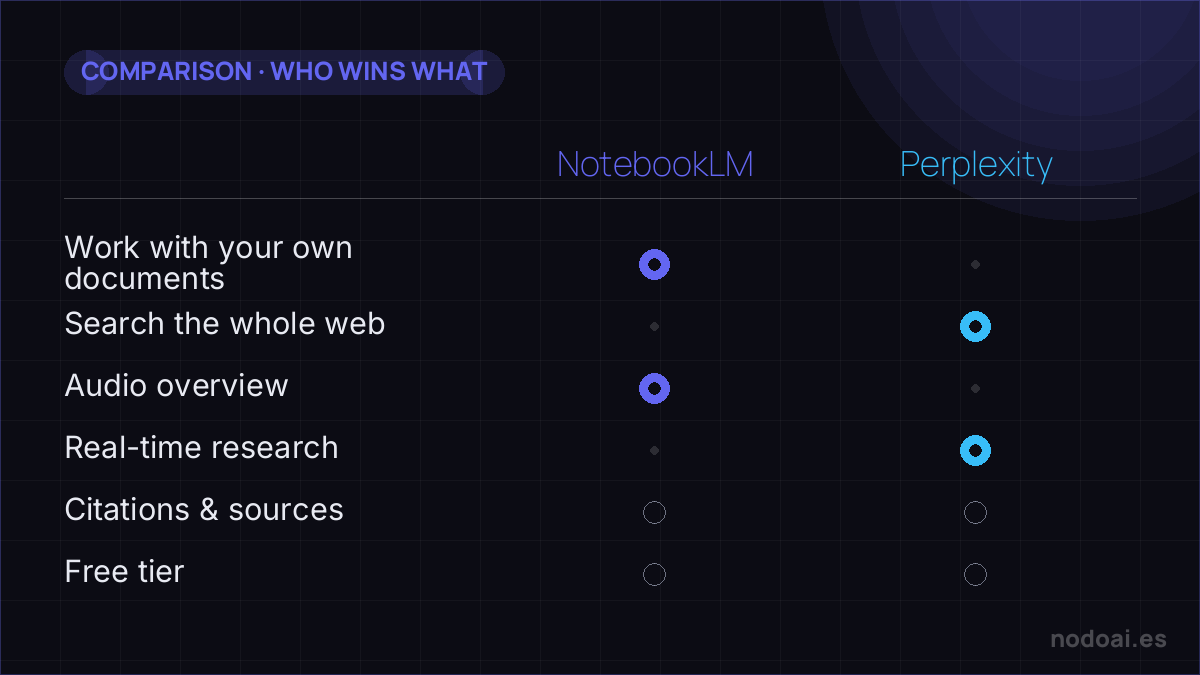
- NotebookLM is built for your own sources — upload PDFs, notes or docs and it answers only from them, with citations and even an audio overview. Perfect for studying a closed set of material.
- Perplexity is built for the open web — live search across the internet with sources. Perfect for researching something you don't already have.
They complement each other: use Perplexity to gather and understand a topic broadly, then drop your best sources into NotebookLM to study them deeply. Closed set vs open web — that one question tells you which to open.
Our recommendation: when to use each
- If the question is “what do MY documents say?”, NotebookLM without hesitation. Answering only from your sources is its superpower: less hallucination and checkable citations.
- If the question is “what’s known about this?”, Perplexity. Its charm is discovering what you didn’t have.
- What we do: the combo. Perplexity for the discovery phase and gathering sources; NotebookLM for going deep on the chosen ones. Researching this way is a different sport.
Our honest opinion: they’re not rivals, they’re two phases of the same job. The right question isn’t which is better but which phase of research you’re in.
Beyond answering: what really sets them apart
- NotebookLM goes past chat: it generates podcast-style audio summaries from your own sources, organises notebooks per project and lets you cross-question dozens of documents at once. For studying or prepping a topic, that “listen while you do something else” format is a real habit change.
- Perplexity bets on guided research: with focus modes (academic, web) and spaces to group the searches of one project, it keeps a long investigation on track instead of scattering twenty tabs.
- The practical upshot: NotebookLM rewards having your sources already gathered; Perplexity rewards still gathering them. That is why they chain together so well.
Frequently asked questions
Can I use both on the same project?
That is exactly what we recommend: start in Perplexity to find and filter sources, keep what matters and upload it to NotebookLM to work through it with checkable citations. Two tools, one research flow.
Which hallucinates less?
NotebookLM, by design: limited to your sources, it tells you when something isn’t there. Perplexity cites sources but summarises the internet, so verify what matters in the links.
Are both usable for free?
Both have a free tier that’s enough to start. Test your real use case before paying anything; limits change often.
Conclusion
NotebookLM rules your documents; Perplexity rules the open internet. Combine them by phase and you have the best research workflow available today. To go deeper on each: NotebookLM in depth and Perplexity, the answer engine.