ChatGPT or Perplexity for searching and researching in 2026? It’s one of the most common questions, because they look the same but aren’t. We use them daily for different things; here’s the honest comparison so you know which to open depending on what you need.
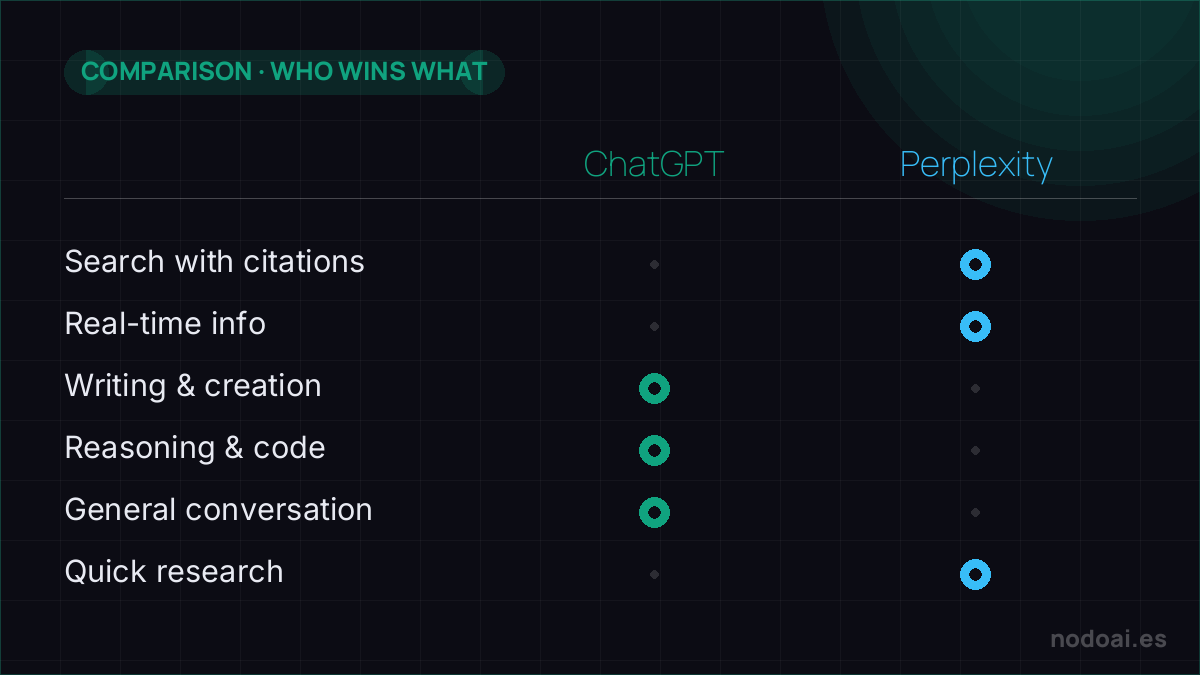 ChatGPT vs Perplexity: Perplexity to search and research with fresh citations; ChatGPT to create, reason and code." width="1200" height="675" loading="lazy"/>
The underlying difference
ChatGPT is a generalist assistant: it converses, writes, codes and reasons, and “knows” from its training. Perplexity is an AI search engine: it answers with cited sources and up-to-date data from the web. They don’t compete at the same thing: one creates, the other researches.
ChatGPT: where it shines
- Writing, summarising, coding and thinking out loud.
- Long, creative tasks where tone matters.
- The most complete ecosystem (voice, images, GPTs).
- Its weak point for research: it can invent data or quotes if it doesn’t verify on the web.
Perplexity: where it shines
- Searching and researching with cited sources you can check.
- Current data, not “from memory”.
- Reaching the original sources fast before writing.
- Its weak point: it’s not the best option for long-form writing or deep conversation.
Quick comparison
| Criterion | ChatGPT | Perplexity |
|---|---|---|
| Searching with sources | Limited | Excellent |
| Writing and creating | Excellent | Decent |
| Up-to-date data | Version-dependent | Yes, by default |
| Verifying where data comes from | Manual | Cites the source |
Quick table: which one for each task
| For what | Better option |
|---|---|
| Researching a topic with cited sources | Perplexity |
| Writing, summarising or shaping a long text | ChatGPT |
| Recent data and current events | Perplexity |
| A long, creative conversation about an idea | ChatGPT |
| Checking a claim before you cite it | Perplexity |
| Working on your own uploaded documents | ChatGPT |
The practical read: Perplexity is your search engine with a brain and citations; ChatGPT is your writer and thinking partner. Most professionals use both, not one.
They're not really rivals — they're a team
People frame this as a fight, but the two shine at opposite jobs:
- Perplexity is a search engine that answers with live sources — best for research, current facts and anything you need to cite.
- ChatGPT is an assistant that creates and reasons — best for writing, brainstorming, coding and long back-and-forth.
The workflow many power users land on: research in Perplexity, create in ChatGPT — and use Perplexity again to fact-check what ChatGPT wrote. Asking “which is better” is like asking whether a library or a notebook is better; you want both, for different moments.
Our recommendation: which to use for your case
- For research and fact-checking: Perplexity, no doubt. Citing the source saves you blunders.
- For creating, writing or coding: ChatGPT. It’s more complete and versatile for producing.
- The combo that works best for us: Perplexity to research and gather sources, then ChatGPT (or Claude) to write from there. The best of each.
Our advice: don’t look for “the best”, because they do different things. If you only pick one, it depends on your use: research → Perplexity; creation → ChatGPT. And remember to always verify important data, wherever it comes from.
Frequently asked questions
Does Perplexity replace Google?
For many searches, yes: it gives you the answer with sources instead of ten tabs. For others (shopping, maps, specific sites), Google is still more practical.
Can I use just one?
Yes, but you lose out. The ideal is Perplexity for searching and a generalist chatbot for creating. The free versions are plenty to combine them.
Conclusion
ChatGPT creates, Perplexity researches. Use them together and you’ll have a workflow that’s hard to beat. For more comparisons, see ChatGPT vs Gemini vs Claude and how to choose your AI assistant.
Related: AI browsers in 2026.
And against the classic search engine? See our Perplexity vs Google comparison.
And for researching your own documents? NotebookLM vs Perplexity.