In 2026, terminal AI agents have become the most powerful way to code with artificial intelligence. The big three—Claude Code (Anthropic), Codex CLI (OpenAI) and Gemini CLI (Google)—compete to live in your console and work over your whole project. We’ve used them in depth; here’s the honest comparison, no marketing.
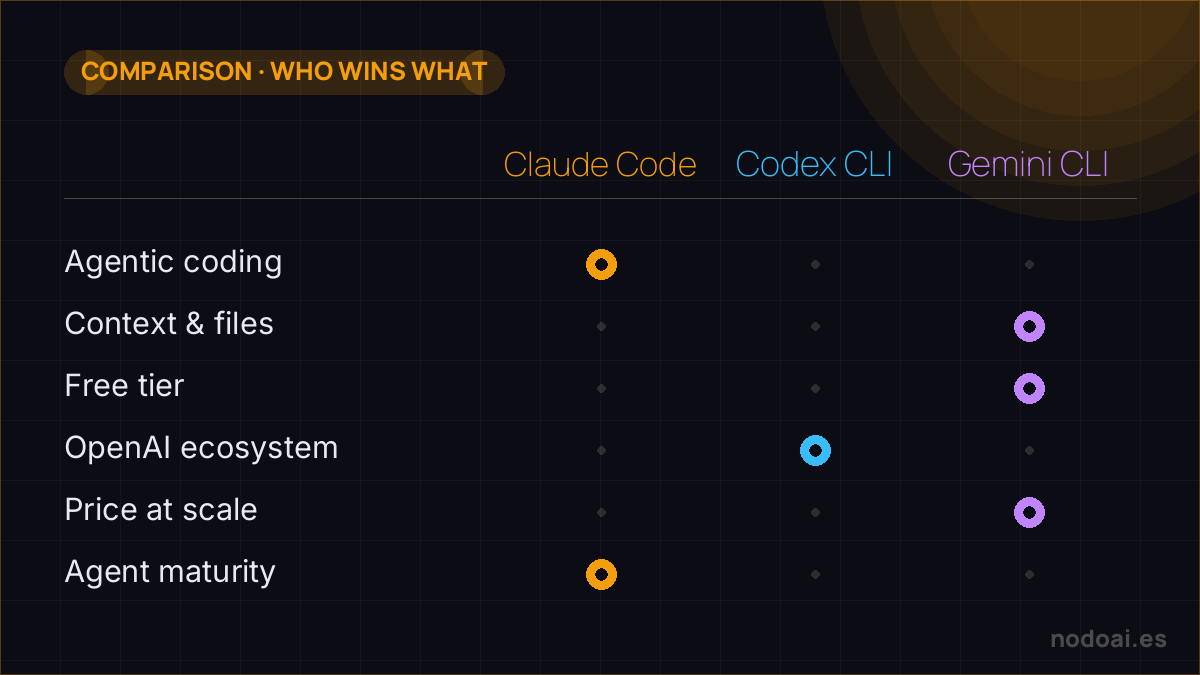 Claude Code vs Codex CLI vs Gemini CLI: Claude Code leads agentic work; Gemini CLI wins on free tier and context; Codex for the OpenAI ecosystem." width="1200" height="675" loading="lazy"/>
What is a terminal AI agent
Unlike a chatbot you copy-paste code to, a terminal agent lives in your console, reads your entire repository, edits several files, runs commands and tests the result. You assign it a task (“add tests to this module and fix what fails”) and it works autonomously, showing you the changes. It’s the leap from “AI that suggests” to “AI that does”.
Claude Code (Anthropic)
- Its strength: reasoning over large codebases and multi-step tasks. It holds the project context and makes fewer mistakes in long chains of changes.
- Fast mode: speeds up output without dropping to a smaller model, available on Opus 4.8/4.7/4.6 with the
/fastcommand. - Ecosystem: integrates well with MCP to connect external tools and data.
- Who it’s for: anyone wanting the most solid agent for serious engineering work in the terminal.
Codex CLI (OpenAI)
- Its strength: integration with the OpenAI ecosystem and the reasoning models. Convenient if you already live in ChatGPT and its tools.
- Experience: fast for scoped, well-defined tasks; good performance in generation and debugging.
- Who it’s for: teams already settled in OpenAI who want to bring that power to the terminal.
Gemini CLI (Google)
- Its strength: Gemini’s huge context window and integration with the Google ecosystem. Useful for taking in a lot of code or documentation at once.
- Availability: it usually has a generous free tier, which makes it attractive to start.
- Who it’s for: anyone already working in Google Cloud or who wants to try terminal agents at no upfront cost.
Quick comparison
| Criterion | Claude Code | Codex CLI | Gemini CLI |
|---|---|---|---|
| Reasoning on long tasks | Excellent | Very good | Good |
| Context (code at once) | Very good | Good | Excellent |
| Ecosystem | Anthropic + MCP | OpenAI | Google Cloud |
| Free tier to start | Plan-dependent | Plan-dependent | Generous |
Exact prices and limits change fast; always check each company’s official documentation before deciding.
Our recommendation: which to choose for your case
We code with all three daily, so this comes from experience, not the brochure:
- For serious engineering work and big refactors: Claude Code is the one that fails us least in long chains; it’s our first choice when the task is complex.
- If you already live in OpenAI: Codex CLI saves you friction and performs very well on scoped tasks.
- To start at no cost or with a huge codebase: Gemini CLI, for its free tier and giant context.
What we learned the hard way: none of them replaces reviewing the diff. All three speed you up enormously, but a confident agent is also confidently wrong. Give it clear, scoped tasks, and always review before merging. Our advice: test your own real task on two of them before committing to any; the difference depends a lot on your project.
Frequently asked questions
Which is the best terminal agent in 2026?
There’s no absolute “best”. For reasoning on long tasks we go with Claude Code; for the OpenAI ecosystem, Codex CLI; for huge context and starting free, Gemini CLI.
Do I need to know how to code to use them?
Yes. These are developer tools: they speed you up a lot, but you have to understand the code they generate to review and fix it.
Are they safe for my code?
They run real actions on your repository, so give them scoped permissions, work on branches and always review the diff before confirming changes.
Conclusion
Terminal agents are the best thing to happen to coding with AI in 2026. If we had to pick one by default, it would be Claude Code for its solidity; but the sensible move is to test your real case. And connect them to your tools via MCP to get the most out of them.
Next: our guide on how to use Claude Code step by step and the GitHub Copilot vs Cursor vs Claude Code comparison.
Related: The state of AI agents in 2026.
Resource: Claude Code Skill (ready-to-use role and rules).
Tempted to describe and let code appear? Vibe coding: when yes, when no.