A cover letter still makes the difference in many applications, but almost nobody enjoys writing one. AI drafts it in seconds… and that’s the danger: recruiters instantly recognize a generic ChatGPT letter. This guide explains how to use AI to write a cover letter that truly stands out —personalized, human and specific to each job—, not just another template.
The mistake that gets you rejected
Asking the AI “write me a cover letter” and sending whatever comes out is the fastest route to the bin. You get something correct but empty: “I’m a passionate, proactive professional” says nothing and sounds like the other 200 letters. Recruiters read dozens a day and spot the mold in a second. Used well, AI does the opposite: it helps you sound more like you and more relevant to that job.
How to do it right, step by step
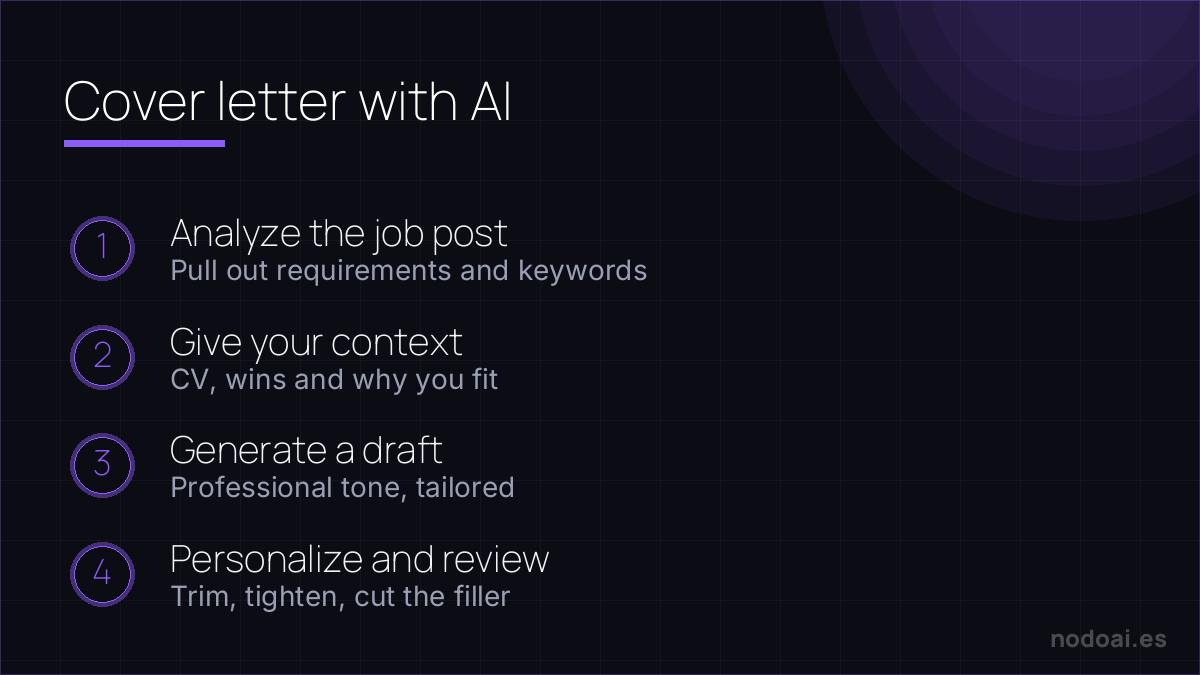
- Give it raw material: paste the job posting and your CV or achievements. Without your data, AI can only invent clichés.
- Ask it to connect, not decorate: “relate my experience in X to what this job asks for”. The value is in the fit, not the adjectives.
- One letter per job: ask it to personalize by mentioning the specific company and role. Generic ones show.
- Rewrite it in your voice: cut the fluff, add a real achievement with numbers and a sincere reason for that company.
- Shorten it: half a page is enough. AI tends to pad; you trim.
What to include (and what’s filler)
| Include | Avoid |
|---|---|
| Why you fit THAT job | “Passionate, proactive, hard-working” with no proof |
| One concrete achievement with a result | Repeating the whole CV |
| Why that company interests you | Lines that would fit any company |
| A brief call to action | Pages and pages of text |
The honest warning
- Don’t lie: AI can “inflate” your profile with things you haven’t done. It collapses in an interview. Make every line true.
- Verify company facts: if you mention a project or company value, check it’s real; AI can invent it.
- Protect your data: avoid pasting sensitive personal information into tools without privacy guarantees.
- The voice is yours: if it sounds like a robot, rewrite it until it sounds like a person.
A good example prompt
Instead of “write me a letter”, try something like: “You are a career coach. With this job posting [paste] and my experience [paste], write a half-page cover letter that connects my achievements to what they ask for, mentions the company, and sounds natural and honest, with no generic phrases.” The more context, the better the result.
What we learned with cover letters and AI
We’ve written letters with AI and also been on the other side, reading applications. That made clear what works:
- The generic AI letter is spotted instantly. When you read several in a row, the “I’m a passionate, proactive professional” ones all blur together. They don’t get rejected for using AI; they get rejected because they say nothing.
- What does stand out is the concrete fit. The letters that worked best for us gave the AI the job posting and our achievements and asked it to connect the two, mentioning the company. Then we rewrote them to sound like us.
The advice we give: use AI to structure and save time, but personalize every letter and tell the truth. An honest, specific half-page letter always beats a perfect but empty one.
Our experience with cover letters and AI
We’ve written letters with AI and we’ve also been on the other side, reading applications. That made it clear what works:
- The generic AI letter is spotted instantly. When you read several in a row, all the “I’m a passionate, proactive professional” ones blur together. People aren’t rejected for using AI; they’re rejected because the letter says nothing.
- What stands out is the concrete fit. The letters that worked best for us gave the AI the job posting and our achievements and asked it to connect the two, naming the company. Then we rewrote them so they sounded like us.
The advice we give: use AI to structure and save time, but personalise every letter and tell the truth. An honest, specific half-page letter always beats a perfect but empty one.
Frequently asked questions
Can recruiters tell if AI wrote it?
They spot the generic ones, which are usually unedited AI. A personalized letter, with real achievements and your voice, passes fine, whether an AI polished it or not.
Should I use the same letter for every job?
No. The strength is personalizing per job: company, role and why you fit. That’s exactly where AI saves you time without losing personalization.
Is it honest to use AI for this?
Yes, as long as what you say is true. AI helps you draft and structure; the facts and merits must be yours and real.
How long should it be?
Half a page, three or four paragraphs. AI tends to pad; trim to the essentials.
Does it also work for LinkedIn or outreach emails?
Yes, the same approach (personalize and connect your value to what they need) works for messages to recruiters, with a shorter tone.
The bottom line
- A generic AI letter gets you rejected; a personalized one stands out.
- Give it the job posting and your achievements, and ask it to connect, not decorate.
- Rewrite it in your voice, be honest and trim to half a page.
- One letter per job: mention the specific company and role.
Worth a look: how to make a CV with AI and the ChatGPT guide for work.