
Starting a blog with AI is tempting: it seems like you could generate hundreds of articles and flood Google with traffic. The 2026 reality is the opposite: blogs that just spew AI text don’t rank, don’t sell and sometimes don’t even get indexed. AI does help —a lot— if you use it as a copilot. This guide explains how to start a blog with AI that actually works, step by step and without falling for the mass-content trap.
The mistake that sinks most AI blogs
Mass-generating articles with AI and publishing them without adding anything is exactly what Google penalizes as scaled, low-value content. You see it daily: blogs with 300 posts and zero visits. Search rewards what helps the reader and shows real experience (what they call E-E-A-T), not quantity. AI doesn’t change that rule: it amplifies it both ways. With that clear, let’s do it right.
How to start the blog, step by step
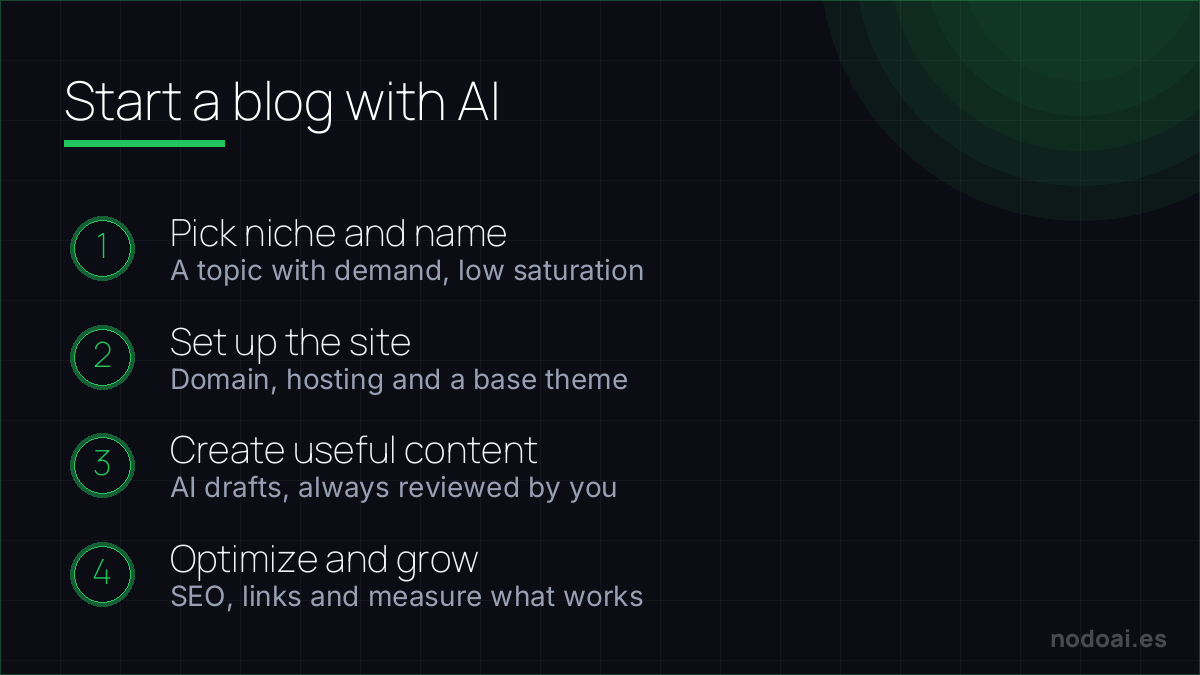
- Pick a specific niche: “AI for photographers” pays off more than “technology in general”. Specificity is your edge.
- Set up the base: a WordPress (or another platform) with a clean, fast theme. The tech matters less than the content.
- Research what people search: use AI to find real questions and group topics, not to invent.
- Write with AI as a copilot: draft with AI, but add your experience, your own examples and judgment. Rewrite until it sounds like you.
- Edit and verify: cross-check facts, correct and structure (headings, lists). AI invents; you verify.
- Publish consistently, not in a flood: one good article a week beats 50 mediocre ones at once.
Where AI genuinely adds value
- Ideas and structure: topic brainstorming and article outlines in minutes.
- Drafts: a first version you turn into something valuable.
- SEO support: titles, meta descriptions and subtopic detection.
- Repurposing: turning an article into a thread, newsletter or video script.
- Images: covers and simple graphics without a stock library.
Where you should NOT delegate
Don’t delegate the real experience (what you know and others don’t), the fact-checking or the blog’s voice. An article anyone could get by asking ChatGPT adds nothing new to the internet, and Google notices. Your edge is exactly what AI lacks: your judgment, your cases and your honesty.
What about monetizing it?
A blog is monetized with advertising, affiliate or your own products, but all of that comes after the traffic, and traffic comes from useful, consistent content. On top of that, ad networks (like Google AdSense) reject sites with mass, low-value AI content. So: doing it right isn’t just better SEO, it’s a requirement to be able to monetize.
Our experience (and our own stumble)
We’ve lived this firsthand with this very site, so we speak from experience:
- Publishing a lot, fast, didn’t work. Filling the blog with articles that had no angle of their own brought neither traffic nor trust; what moved us forward was stopping, pruning what was excess, and going deeper on what genuinely added value.
- AI as a copilot, yes; as the sole author, no. Our best pieces start from an AI draft but carry our experience, real examples and a clear opinion on top. The ones we left “as they came out” were the weakest.
If we had to start from scratch, we’d write fewer, better articles, with a clear niche and consistency. Quantity fools no one; real value does show.
Frequently asked questions
Can I start a 100% AI blog?
You can generate it, but it won’t work: without your experience and editing it’s generic content that neither ranks nor can be monetized. Use AI as a copilot, not the sole author.
Does Google penalize AI content?
It doesn’t penalize using AI; it penalizes scaled, low-value content, whoever produces it. If you add real value, using AI isn’t a problem.
How many articles should I publish?
Quality over quantity. It’s better to publish something good consistently (say, weekly) than to flood the blog with mediocre text.
How long until it sees results?
Months, usually. Ranking and building an audience is a marathon; AI speeds up production, not Google’s timelines.
Do I need to know SEO?
The basics help: find what people want, structure well and link. AI assists you, but the judgment of who you’re writing for is yours.
Worth remembering
- Mass AI content doesn’t work: Google rewards value, not quantity.
- Pick a niche, use AI as a copilot and add your experience and verification.
- Publish consistently and with quality, not in a flood.
- Doing it right is a requirement both to rank and to be able to monetize.
Related reading: what prompt engineering is and how to write a book with AI.