AI can help you write a book much faster: ideas, structure, drafts, editing. What it can’t do is write it well for you without your judgment. This guide explains how to genuinely use AI to write a book or ebook in 2026 —as a copilot, not autopilot—, step by step and with honest warnings about quality, rights and publishing.
First: AI is a copilot, not the author
A book written 100% by AI, without your voice or review, is usually flat, generic and forgettable —and marketplaces are flooded with them, with no sales. AI shines when you add your experience, your angle and your editing on top. Think of it as a tireless assistant: it researches, organizes and drafts; you decide, correct and give it soul. With that clear, let’s get to the process.
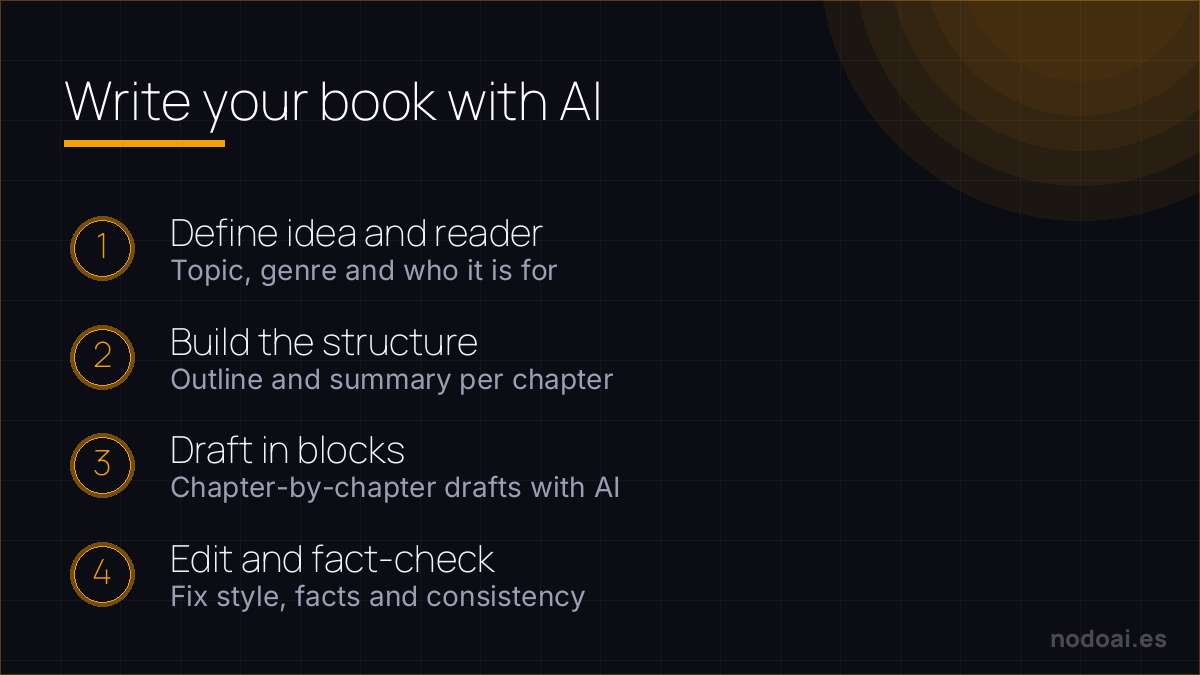
The step-by-step process
- Define the idea and the reader: what’s it about, for whom, what problem does it solve or what story does it tell? Without this, AI rambles.
- Structure first: ask AI for a table of chapters and sections. Review and reorder it: the skeleton is yours.
- Draft by chapters: work chapter by chapter giving context (tone, examples, what to include). Never “write me the whole book”.
- Rewrite in your voice: take the draft and make it yours: your examples, your experience, your way of explaining.
- Editing and consistency: use AI to spot repetition, gaps and errors; you decide the changes.
- Final human review: read it in full. AI doesn’t guarantee facts or continuity; you do.
Fiction vs. non-fiction
| Type | Where AI helps | Where you lead |
|---|---|---|
| Non-fiction (guides, explainers) | Structure, explaining concepts, examples, summarizing sources | Your real experience and the accuracy of the facts |
| Fiction (novel, short story) | Brainstorming, sketching scenes, breaking the block | Voice, characters, emotion and narrative consistency |
Honest warnings (quality, facts and rights)
- Verify the facts: in non-fiction, AI can invent figures, quotes or sources. Check everything you claim.
- Mind the platforms: some stores (like Amazon KDP) require disclosing AI use and limit mass publishing. Get informed before publishing.
- Originality: don’t publish generic, unedited text; besides not selling, it can resemble others’ work.
- Rights: check the tool’s license for commercial use of what you generate.
The tools you need
Fewer than you think: a good AI assistant (ChatGPT, Claude) to ideate and draft, your usual word processor to write and edit, and optionally a layout tool for the final ebook. If you’ll reuse the same style a lot, building a Custom GPT with your tone saves repeating instructions.
What we learned writing long-form with AI
We’ve used AI to structure and draft long documents, and the difference between it helping or hindering is in how you use it:
- Asking “write me the whole chapter” always produced filler. We switched to working section by section, giving it context and our own examples, and the text went from generic to usable.
- Structure is where it helps most; voice, where it helps least. The outline and skeleton come fast, but the tone and real examples we add ourselves, or the result sounds like anyone.
- The moment there are facts, we verify, period. More than one “confident” figure turned out invented. In non-fiction, publishing without checking is a gamble.
Our takeaway: AI is an excellent copilot to get going and beat the blank page, but you write the book; it just removes the mechanical part.
Frequently asked questions
Can I write an entire book with AI?
Technically yes, but the result without your editing is usually generic and doesn’t sell. Use it as a copilot: drafts and ideas that you rewrite and review.
Is it legal to publish a book written with AI?
Generally yes, but some platforms require disclosing it and limit mass publishing. Check the rules of the store where you publish and the tool’s license.
Does AI invent facts?
It can do so with full confidence. In non-fiction, verify every figure, quote and source before publishing. The responsibility is the author’s.
How long does it take?
Much less than by hand, but it’s not instant: the slow, valuable part is your rewriting and editing, not the generation.
Does it work for novels?
It helps to ideate and break the block, but voice, characters and emotion come from you. 100% AI fiction usually sounds empty.
The bottom line
- AI is a copilot: it speeds up ideas, structure and drafts; you bring voice and judgment.
- Work by chapters with context, never “the whole book” at once.
- Verify facts, protect originality and check the platform’s rules.
- Human rewriting and editing are what make the book worth it.
You may also like: what prompt engineering is and how to create your own Custom GPT.
Relacionado: how to start a blog with AI.