Gemini vs Claude is the comparison no one does and the one that matters most if you take AI seriously: they’re the two direct rivals to ChatGPT, and each wins at very different things. Here we put them head-to-head on what you actually use — writing, code, reasoning, long context, price, and ecosystem — without staying on the surface.
 Gemini vs Claude: Claude to think, write and code; Gemini for price, multimodal and the Google ecosystem." width="1200" height="675" loading="lazy"/>
What happened
For years the conversation was “ChatGPT and the others.” Not in 2026: Claude (Anthropic) and Gemini (Google) go toe-to-toe with OpenAI, and in several areas they surpass it. Choosing between them stopped being trivial.
These are different philosophies: Google integrates Gemini across its entire ecosystem (Search, Workspace, Android); Anthropic bets on a careful model, strong in reasoning and writing, beloved by developers.
Why it matters
If you pay for an AI subscription (~$20/month) or build something on top of an API, choosing wrong costs you money and frustration. There’s no absolute winner — there’s a winner for your case. Knowing where each one excels saves you months of trial and error.
Writing and conversation
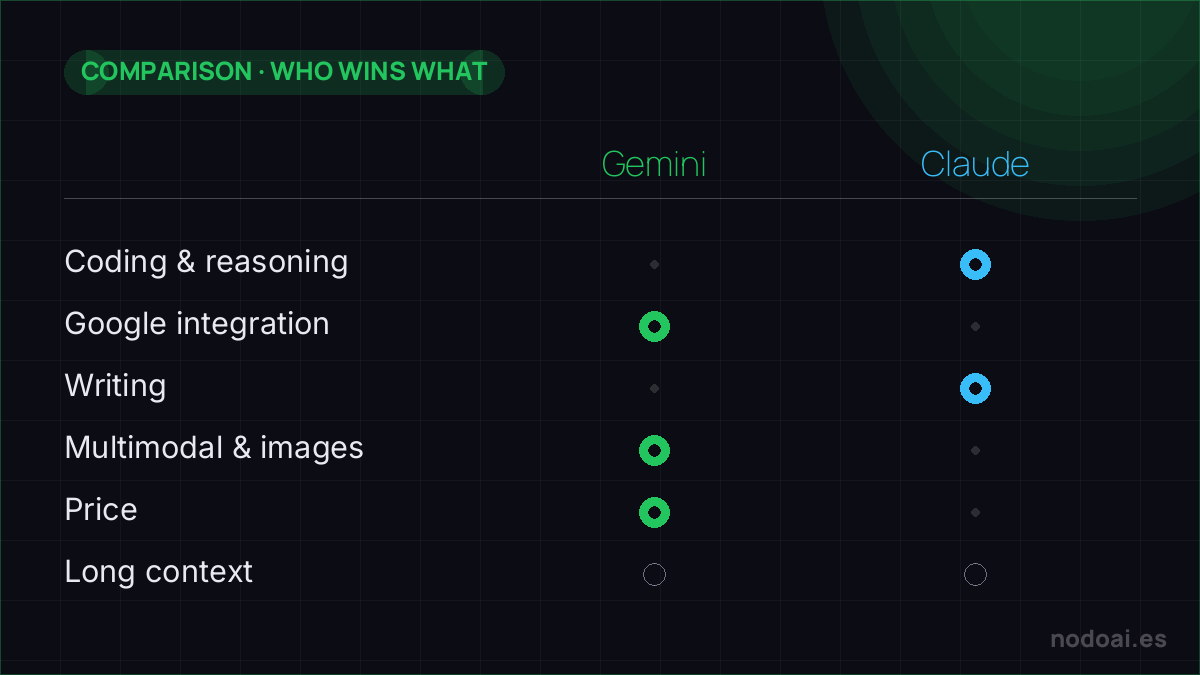
Claude is, for many people, the best at writing: natural, nuanced text with good style judgment and less “AI flavor.” Excellent in English. Gemini writes well and has the advantage of accessing current Google information, useful for text that needs fresh data. For pure writing, Claude; for text with up-to-date facts, Gemini.
Programming
Claude is the favorite of many developers: reasons well about code, keeps context across large projects, and makes fewer silly mistakes. Gemini has improved a lot and integrates with the Google ecosystem (Colab, Android Studio). For complex code and refactors, Claude usually leads; for people who live in Google tools, Gemini fits better.
Reasoning and hard problems
Both have powerful reasoning modes. Gemini shines on tasks that benefit from searching and cross-referencing information; Claude, on structured reasoning and careful analysis of long documents. Technical tie decided by the type of problem.
Long context and documents
Both are extremely strong here: they handle hundreds of thousands of words (full books, codebases, mountains of PDFs). Gemini has pushed the context limits higher; Claude stands out for the quality of analysis within that context. If you work with huge documents, either will do — test with your real files.
Ecosystem and integration
Gemini wins hands down if you live in Google: it’s in Gmail, Docs, Sheets, Android, and Search. That integration is its biggest asset. Claude has fewer native integrations but a well-loved API and excellent developer tools (Claude Code).
Pricing
Paid plans for both hover around $20/month for personal use, with higher tiers for professionals. Gemini often includes benefits if you already pay for Google One or Workspace. On the API side, pricing varies by model — compare based on your expected volume.
Which to choose for your case
- You write a lot (articles, copy, emails): Claude.
- You live in Gmail, Docs, and Android: Gemini.
- You code seriously: Claude.
- You need current data and search: Gemini.
- You carefully analyze long documents: Claude.
- You want everything integrated without thinking about it: Gemini.
Limitations of each one
- Claude: fewer native integrations, no equally mature native image generation, and sometimes more cautious than necessary.
- Gemini: quality can vary between versions, and deep Google integration is either an advantage or a leash depending on your case.
Our verdict
If we had to sum it up: Claude is the careful brain — quality writing and code; Gemini is the integrated assistant — all of Google at hand and fresh data. Most people don’t need to pick forever: many use Claude to create and Gemini to search and integrate.
And remember this changes fast: you’ll notice the real difference by testing both with YOUR work, not by reading benchmarks.
Practical recommendation: take one of your real tasks (a text, a code snippet, a document) and run it through both this week. In 20 minutes you’ll know which fits you better than any comparison can tell you.
Related on NodoAI: pair this with ChatGPT vs Claude, our Gemini review, and our Claude review.