DeepSeek shook the industry in 2025 with a reasoning model that matches OpenAI’s at a fraction of the cost. By 2026, it’s a serious alternative to ChatGPT — for some use cases. Here’s the honest comparison: when DeepSeek beats ChatGPT, when it doesn’t, and how to pick the right one for your case without falling for hype.
We’ve put both through the same prompts: complex code, multi-step math, long-form writing in English and Spanish, document analysis and casual chat. The results are not what marketing claims.
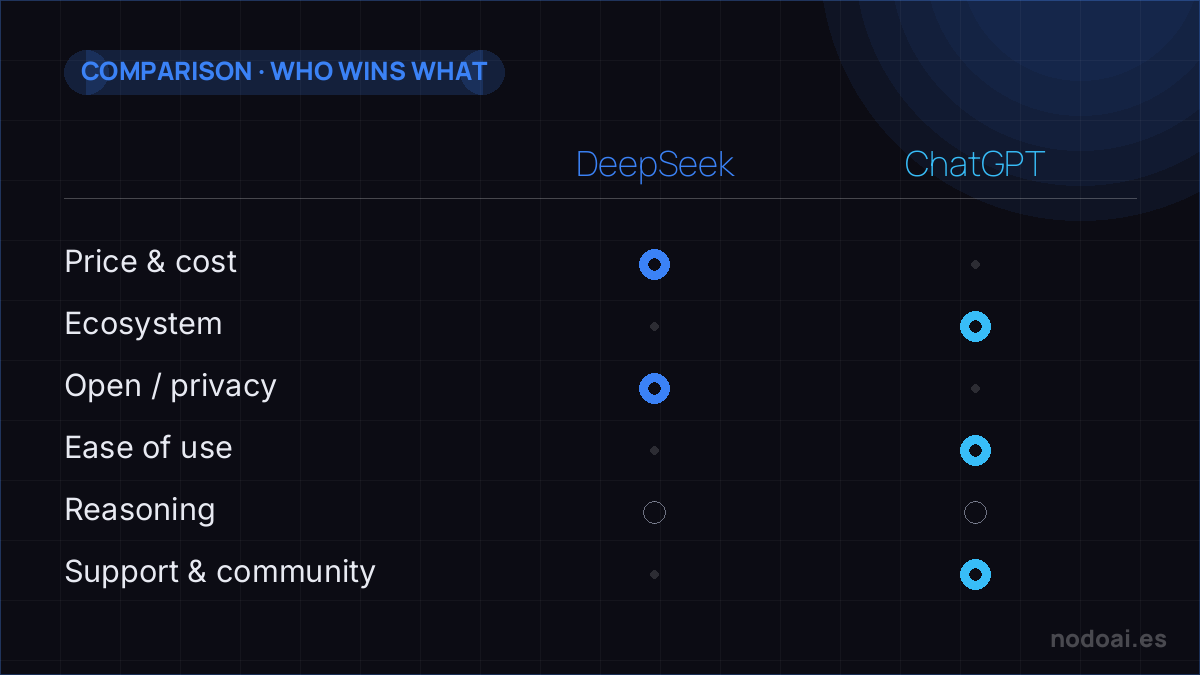
Executive summary
| Criteria | DeepSeek | ChatGPT |
|---|---|---|
| Best model | DeepSeek-R1 / V3 | GPT-5.5 / o3 |
| Reasoning & math | Excellent | Excellent |
| Code generation | Very good | Excellent |
| Long-form writing | Good | Excellent |
| Multimodal | Limited | Mature |
| API input price | ~$0.27/M tokens | ~$2.50/M tokens |
| API output price | ~$1.10/M tokens | ~$10/M tokens |
| Self-hosted | Yes | No |
Where DeepSeek beats ChatGPT
Price (by 5-10x)
DeepSeek’s API costs roughly $0.27 per million input tokens vs. ChatGPT’s $2.50 — about 9x cheaper. For apps making thousands of API calls per day, monthly savings can be $500-5,000+. This is DeepSeek’s biggest practical advantage.
Step-by-step reasoning
DeepSeek-R1 reasons out loud (chain of thought) and on competitive math problems (AIME, MATH) matches o1/o3. For technical research and logic problems, you’ll see no meaningful difference between R1 and ChatGPT’s best reasoning model.
Open weights and self-hosting
DeepSeek publishes its weights on Hugging Face. You can run it on your own server (Ollama, vLLM) and your data never leaves your infrastructure. For healthcare, financial or legal-compliance use cases, this is decisive.
Where ChatGPT beats DeepSeek
Long-form writing in English
ChatGPT generates more polished, natural and editorially refined text. For marketing content, professional emails, essays or long-form pieces, GPT-4.5 / o3 still produces output that requires less editing. DeepSeek is functional, but feels less polished.
Multimodal: voice, image and video
ChatGPT has integrated voice (real-time conversation), image generation (DALL-E 3, GPT-Image), document analysis, custom GPTs and an established ecosystem. DeepSeek is mainly text-only with limited image input. If you need a multimodal assistant, ChatGPT is the only option of the two.
Ecosystem and integrations
ChatGPT integrates with thousands of apps (Slack, Notion, Zapier, Microsoft 365), has the GPT Store with templates, custom GPTs and a mature plugin ecosystem. DeepSeek has minimal native integrations. For non-technical users wanting “AI everywhere”, ChatGPT is much more ready.
Privacy beyond self-hosting
If you don’t self-host DeepSeek, your data goes to Chinese servers under Chinese law. ChatGPT (especially Team and Enterprise plans) offers contracts that guarantee no training on your data, EU servers and SOC 2 / ISO 27001 compliance. For most European companies, ChatGPT (paid) is a more defensible privacy choice than DeepSeek-cloud.
Use case verdicts
You’re a developer building AI features
Winner: DeepSeek for cost reasons. If you make many API calls and the savings exceed the polish premium, DeepSeek wins. Many startups use DeepSeek for the heavy lifting and ChatGPT only when the use case demands polish.
You need a polished personal assistant
Winner: ChatGPT. For everyday writing, planning, document analysis and voice conversations, the ChatGPT Plus experience is more polished and integrated. DeepSeek’s web is functional but more spartan.
You handle sensitive data
Winner: DeepSeek self-hosted. The only way to guarantee your data never leaves your control is to run the model in your own infrastructure. DeepSeek is the only of the two that allows it.
You need multimodal (image, voice, video)
Winner: ChatGPT. DeepSeek doesn’t have integrated voice, real-time image generation or video. For multimodal workflows, ChatGPT is the only viable option.
You want maximum value with limited budget
Winner: DeepSeek (web/app). DeepSeek’s web is free with unlimited use and provides 80% of ChatGPT Plus functionality for general tasks. For students, freelancers and bootstrapped users, it’s the most cost-effective option.
Can you combine them?
Yes, and it’s the strategy many professionals use:
- DeepSeek for code and reasoning: cheap APIs for technical tasks where you don’t need an editorial finish.
- ChatGPT for writing and multimodal: polished content, voice conversations, image generation.
Combining them, you can have professional AI coverage for under $30/month and use DeepSeek’s API selectively when volume justifies it.
Our recommendation: which we’d choose for your case
We’ve used them side by side for the same tasks, and the conclusion isn’t “one beats everything”:
- For day-to-day and convenience: ChatGPT. The ecosystem (voice, apps, GPTs, images) and how polished the experience is still make the difference for most people.
- For cost and control: DeepSeek. If price at volume matters, or you want to self-host and fine-tune, its capability/price ratio is hard to beat.
- For reasoning and coding: they’re closer than it seems; there we recommend testing your own case, because the difference depends a lot on the type of problem.
Our honest advice: if you don’t want to overthink it, ChatGPT. If cost or privacy rule, DeepSeek deserves a serious test before dismissing it as “the new one”.
Frequently asked questions
Is DeepSeek really as good as ChatGPT?
For reasoning, math and code, yes — DeepSeek-R1 is competitive with OpenAI’s o1/o3. For polished long-form writing, multimodal and integrated ecosystem, ChatGPT still has an edge.
Is DeepSeek safe for business use?
The official cloud sends data to Chinese servers under Chinese law. For sensitive data, only the self-hosted version is recommended. For general business with non-confidential data, the cloud works with the same caveats as any non-European AI service.
Can I cancel ChatGPT and switch fully to DeepSeek?
For programmers and bootstrapped users, yes — DeepSeek covers 80-90% of use cases for free. For professionals who need multimodal, polished writing or specific integrations, ChatGPT is still useful as a complement.
Does DeepSeek work well in English?
Yes, very competently. The polish in casual English is a bit below ChatGPT, but for technical work, business writing and clear communication, the difference is small.
Related reads on NodoAI
- DeepSeek 2026 full guide · in-depth look.
- DeepSeek tool review · pricing and specs.
- ChatGPT tool review · features and plans.
- State of LLMs 2026 · broader context.