RAG is one of those acronyms that shows up in every serious AI conversation, and almost nobody explains it in plain language. Let’s fix that: RAG (Retrieval-Augmented Generation) is the technique that lets an AI answer using YOUR documents instead of only its memory. It’s what powers “chat with your PDF”, AI search engines and almost every enterprise assistant. And understanding it helps you know when to trust an answer.
The problem it solves (the AI’s memory isn’t enough)
- An AI model only “knows” what it saw in training: nothing about your documents, your company or what happened yesterday.
- And when it doesn’t know, it sometimes makes things up: the famous hallucinations. Asking about your contract without giving it to the AI is asking it to imagine one.
- The obvious fix would be “give it everything”, but context is limited and costly. You can’t paste a thousand documents into every question.
How RAG works, explained with a library
Picture a librarian with a brilliant but outdated memory. RAG gives them a library and a method:
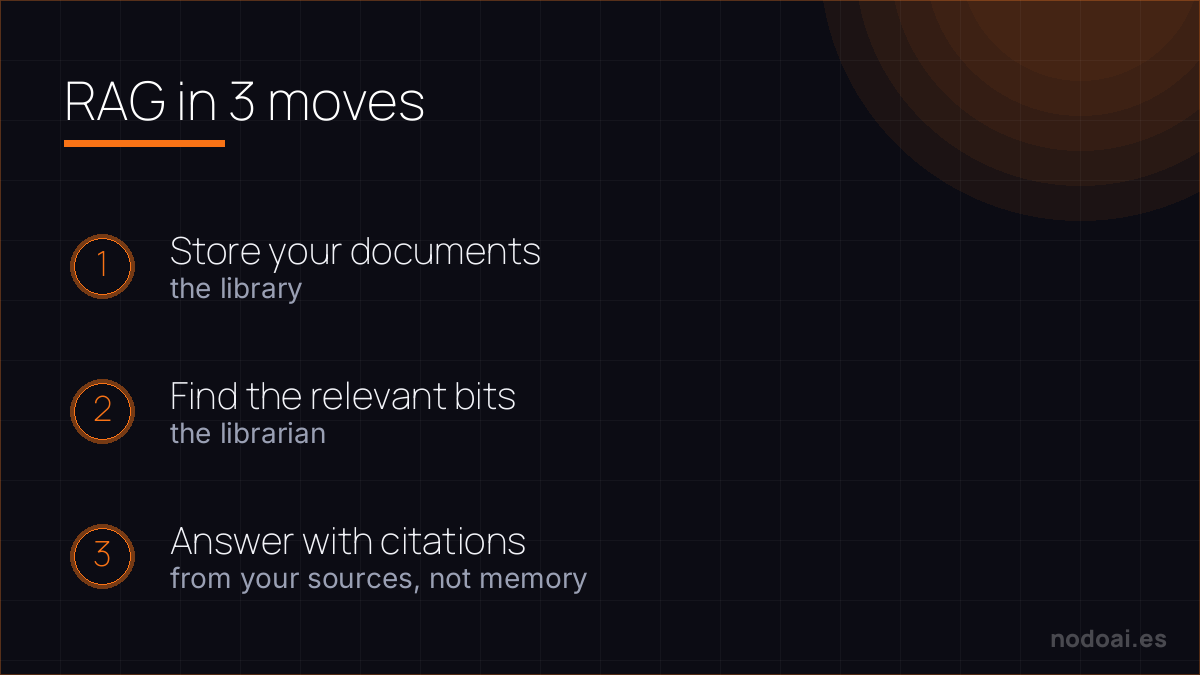
- 1. Index: your documents are chunked and turned into mathematical “fingerprints” (embeddings) that capture their meaning, stored in a special database.
- 2. Retrieve: when you ask something, the system finds the chunks whose meaning is closest to your question — not by exact words, but by sense.
- 3. Generate: the AI receives your question + those relevant chunks and writes the answer based on them, often citing the source.
Result: answers anchored in real documents, instantly updatable (add a document and it “knows” it) and with checkable citations.
Where you already use it (without knowing)
- “Chat with your documents” in ChatGPT, Claude (Projects) or NotebookLM: that’s RAG.
- AI search engines like Perplexity: they retrieve web pages and generate the answer citing them — RAG with the internet as the library.
- Enterprise assistants: the internal chatbot that answers about company policies is almost certainly RAG over its documentation.
Where RAG shines and where it quietly fails
RAG (Retrieval-Augmented Generation) lets a model answer from your documents instead of only its training. It's what powers most useful internal AI assistants — but it's only as good as its retrieval.
- Garbage in, garbage out: if the search step pulls the wrong passages, the answer is confidently wrong.
- Chunking matters: how you split documents decides whether the model finds the right context.
- Cite the source: a good RAG system shows which document it used, so you can verify.
Real uses: a support bot grounded in your help centre, a legal team querying its own contracts, internal onboarding. If answers feel off, fix the retrieval before blaming the model.
Our take: what RAG fixes and what it doesn’t
- It fixes: answers about private or recent information, with less hallucination and sources you can verify.
- It doesn’t fix: if the documents are wrong, the answer will be wrong (“garbage in, garbage out”); and if retrieval grabs the wrong chunk, the AI will answer confidently from the wrong context.
- The habit that protects you: when a RAG system cites sources, click them from time to time. That’s how you catch retrieval failures.
Frequently asked questions
Is RAG the same as training the AI on my data?
No. Training modifies the model (expensive, slow, permanent); RAG just hands it relevant documents at answer time (cheap, instant, reversible). For most cases, RAG is the practical option.
Do I need to code to use RAG?
To use it, no: uploading files to NotebookLM or a Claude Project is already RAG. To build a custom one for a company, you usually do need someone technical.
Conclusion
RAG is the bridge between the general intelligence of models and YOUR specific information — the piece that turns an impressive AI into a useful one for your case. To keep building foundations, see what prompt engineering is and what MCP is, the protocol that connects AI to your apps.