A video of a celebrity saying something they never said, an audio of “the boss” asking for an urgent transfer, a photo that looks real but isn’t. Those are deepfakes, and in 2026 they’re easier to create and harder to tell apart. This guide explains what they are, why they matter and, above all, how to detect them and protect yourself — without paranoia but with judgment.
What a deepfake is
A deepfake is content (video, audio or image) generated or manipulated with AI to look real: one person’s face placed on another, a cloned voice saying whatever you want, a scene that never happened. The term comes from “deep learning” + “fake”. Not all AI-generated content is a deepfake: what defines it is the intent to pass off as real something that isn’t, usually impersonating a specific person.
Why you should care
- Scams: the most dangerous today. They clone the voice of a relative or an executive to ask for urgent money by phone or audio.
- Disinformation: fake videos of public figures to manipulate opinion.
- Reputation: fake images or videos to harm someone.
- Identity fraud: bypassing video verification or impersonating someone on a video call.
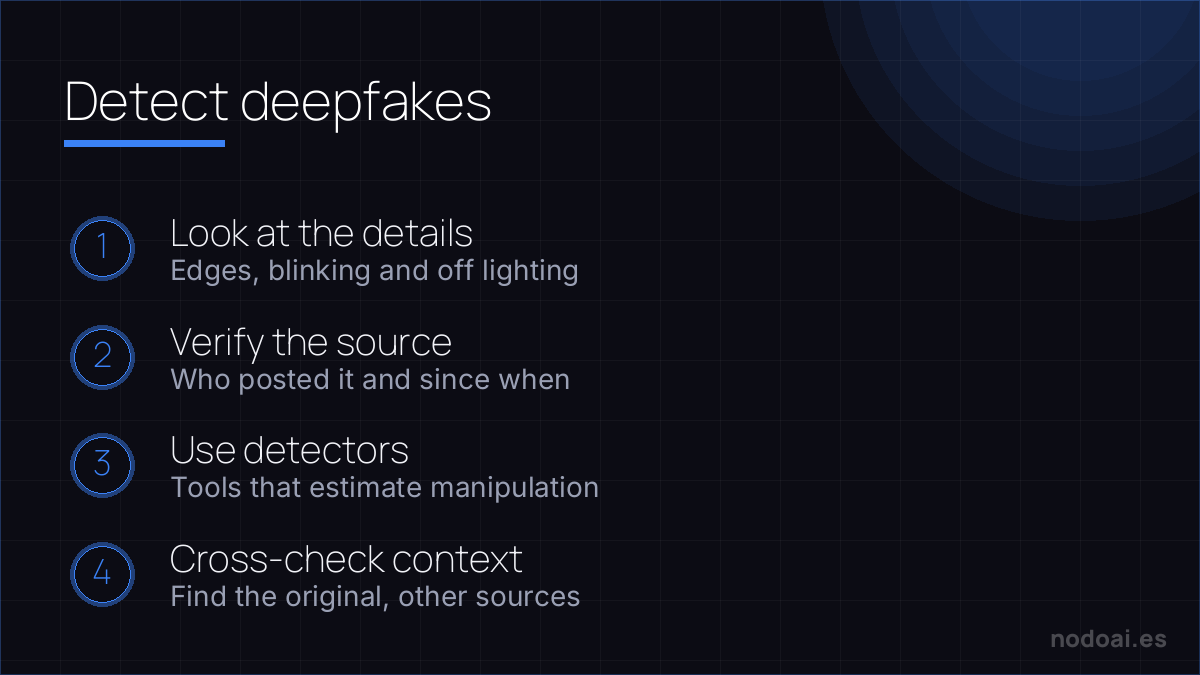
How to detect a video or image deepfake
No single sign is foolproof, but together they raise suspicion. Look for:
- Eyes and blinking: odd gaze, unnatural or absent blinking.
- Face edges: hair, ears or neck where the face “attaches” often fail.
- Lighting and shadows: light that doesn’t match between face and background.
- Mouth and teeth: lips out of sync with audio, blurry teeth.
- Hands and details: deformed fingers, jewelry or backgrounds that distort when moving.
- Suspicious quality: heavily compressed or very short videos “hide” defects on purpose.
How to detect a cloned voice (the most used in scams)
Audio is the most convincing and dangerous today. Signs and defenses:
- Flat intonation or odd pauses, though cloning keeps getting better.
- Urgency + secrecy + money: the classic scam pattern. If they rush you to pay or not hang up, be suspicious.
- Verify on another channel: hang up and call the person yourself on their usual number. This is the best defense, not technology.
- Ask something only that person would know and that isn’t on social media.
Tools and verification methods
There are AI detectors that analyze whether content was generated, but they’re not 100% reliable (they fail both ways), so use them as one more clue, not a verdict. More useful are habits: reverse image search to find the origin, checking whether reputable outlets publish it, and distrusting anything that only circulates through messaging apps. Verifying the source is still more powerful than any detector.
How to protect yourself
- Doubt the urgent: scams rely on haste. Stop, breathe, verify.
- Agree on a code word with your family for phone emergencies.
- Mind your footprint: the fewer public photos and audios of you, the less material to clone you.
- Verify on a second channel whenever money or data is involved.
- Warn your loved ones: older people are the favorite target of voice scams.
What we learned spotting fake content
Covering this topic, we’ve seen plenty of deepfakes go by, and a couple of things stuck with us:
- The cloned-voice scam pattern is always the same: urgency, money and “don’t tell anyone”. The day you internalize that trio, you stop focusing on whether the voice sounds right and start hanging up to call back. That habit is worth more than any detector.
- Detectors have failed us both ways: flagging a real video as fake and a manipulated one as genuine. That’s why we never settle for their verdict; we verify the source and check whether a reputable outlet reports it.
What we keep telling family and friends: faced with an image or audio that’s too surprising, the question isn’t “does it look real?”, but “where does it come from and who else confirms it?”.
Our experience spotting fake content
Covering this topic we’ve seen plenty of deepfakes go by, and a couple of things have stuck with us:
- The cloned-voice scam pattern is always the same: urgency, money and “don’t tell anyone”. The day you internalise that trio, you stop focusing on whether the voice sounds right and start hanging up and calling back. That habit is worth more than any detector.
- The detectors have failed us both ways: flagging a real video as fake and a manipulated one as genuine. That’s why we never settle for their verdict; we verify the source and check whether a reliable outlet reports it.
What we repeat to family and friends: faced with an image or audio that’s too surprising, the question isn’t “does it look real?” but “where does it come from and who else confirms it?”.
Frequently asked questions
Is making a deepfake illegal?
It depends on the use and the country. Using it to scam, defame, impersonate or create non-consensual sexual content is a crime in many places. The technology itself isn’t illegal; malicious use is.
Do deepfake detectors work?
They help, but they’re not 100% reliable: they give false positives and negatives. Use them as a clue, not definitive proof. Verifying the source is more reliable.
How do I know if I’m being called with a cloned voice?
Be wary of urgency + money + secrecy. Hang up and call the person yourself on their usual number, or ask something only they would know. Don’t trust just that it “sounds” like them.
Can I stop my voice or face from being cloned?
Not entirely, but you reduce the risk by limiting your public content and being cautious with what you share. Agreeing on a family code word helps a lot.
Is all AI content a deepfake?
No. A meme or an AI illustration isn’t a deepfake. It is one when it tries to pass off something fake as real, usually impersonating a person.
In a nutshell
- A deepfake aims to pass off something fake as real, usually impersonating someone.
- The biggest danger today is cloned-voice scams: urgency + money + secrecy.
- Detect by the signs, but above all verify the source on another channel.
- Detectors help but aren’t foolproof; your judgment is the best defense.
Go deeper: AI detectors: how they work and why they fail and is AI safe? privacy and your data.
Deepfakes are the basis of many scams: see the new AI scams and how to protect yourself.