Starting to train (or coming back) almost always hits the same wall: not knowing what to do at the gym, copying internet routines that don’t fit you and quitting after three weeks. AI can help you build a plan tailored to you, explain the exercises and adapt it when life gets in the way. That said, let’s start with the important part: this is not medical advice and doesn’t replace a professional. AI guides; your health is supervised by a qualified human.
Where it really helps
- A tailored plan: from your goal, level, the equipment you have (gym, home, just your body) and available days, it builds a structured routine.
- Explaining the exercises: “how to do a squat and common mistakes” in plain language, so you’re not lost.
- Adapting to real life: “I only have 20 minutes today”, “my shoulder hurts, give me alternatives”, “I have no dumbbells”. It readjusts the plan on the spot.
- Keeping consistency: it helps you track, see progress and stay motivated, which is where almost everyone fails.
How to ask for a good plan
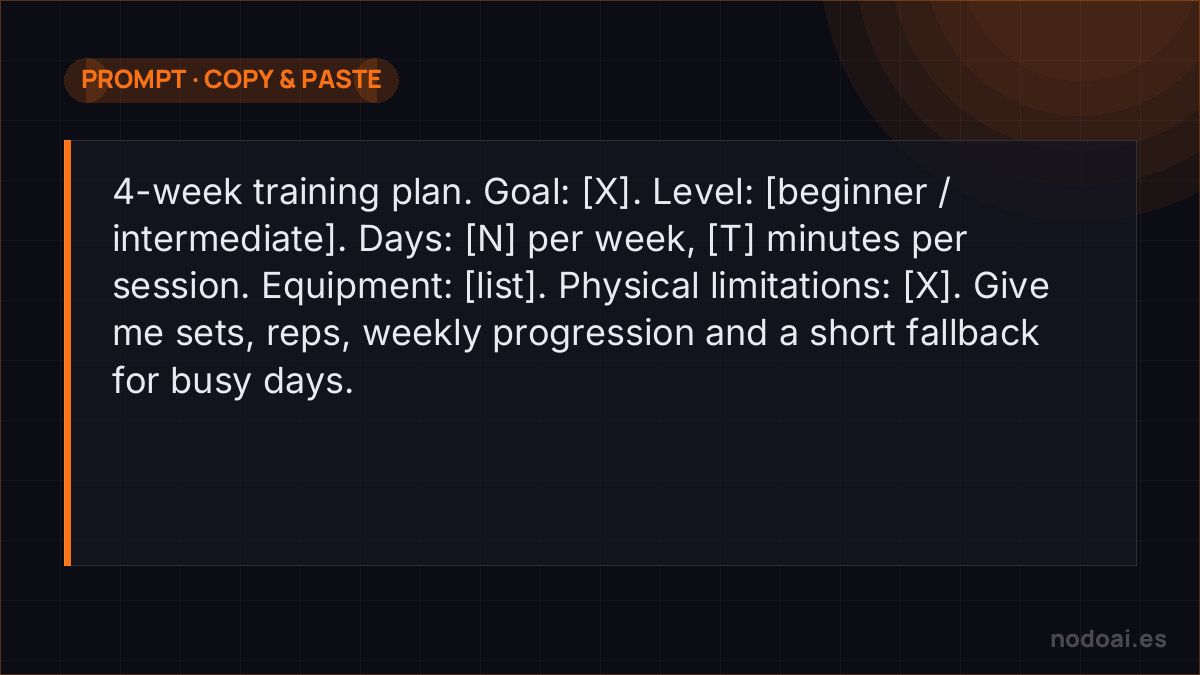
- Full context: goal (strength, fat loss, general health), level, days per week, time per session, equipment and any physical limitation.
- Ask for structure and progression: “4-week plan, with sets, reps and how to progress”. A plan without progression stalls.
- Have it explain the why: understanding what each block is for helps you not drop it.
The red lines (read first)
- It’s not diagnosis or treatment: if you have an injury, a medical condition, are pregnant or haven’t moved in a long time, see a doctor or physiotherapist BEFORE starting. AI doesn’t know your body.
- Technique is learned by being watched: AI describes an exercise, but doesn’t see if you do it wrong. For lifting serious loads, a few sessions with a trainer are worth their weight in gold (and prevent injuries).
- No “miracle plans”: distrust extreme routines or drastic diets. What works is sustainable and boring: consistency and progression.
An AI workout plan — useful, but not a coach or a doctor
AI can build a structured, personalised routine in seconds around your goal, level and available equipment. Where it helps and where you stay careful:
- Great for: structure, progression, variety and explaining exercises you don't know.
- Be specific: give it your experience, injuries to avoid, days per week and gear — vague in, generic out.
- Watch form: AI can't see you; bad technique is how people get hurt.
This isn't medical advice. If you have a health condition, are pregnant or are starting after a long break, check with a doctor first, and consider a real trainer for the first sessions. AI plans the work; your body sets the limits.
Our recommendation
- Use it to start and for consistency: that’s where it adds the most —removing the “I don’t know what to do” excuse and keeping you hooked with a clear plan.
- Combine it with human judgement: AI for the day-to-day; a professional to check technique, aches or if something isn’t progressing.
- Our take: as a pocket coach to guide you and keep you from giving up, it’s fantastic. As a substitute for a doctor or trainer when there’s pain or serious loads, no —there, health rules and a person supervises it.
Frequently asked questions
Can I trust a routine made by AI?
As a guiding starting point for a healthy person, it’s usually reasonable. But it doesn’t know your history or watch you train: listen to your body, progress slowly and, with pain or doubts, consult a professional. This is not medical advice.
Is it good for training at home with no equipment?
Perfectly: tell it you only have your bodyweight and your living-room space and it’ll build a routine with that. It’s one of the most convenient cases to start.
Conclusion
AI is a great push to start training and, above all, to not quit: a tailored plan, explained exercises and on-the-fly adjustments. But remember the rule: it guides, it doesn’t diagnose —for the serious stuff, a professional. To organise the rest of your habits, see how to build routines with a chatbot like ChatGPT and how to protect the privacy of your data when using it.