A job interview is largely won before you walk through the door. AI has become the best interview-prep partner there is: it researches the company, anticipates questions and, above all, lets you rehearse without embarrassment as many times as you need. Here’s how we use it to prepare interviews, with the exact prompts and the clear limits.
How to prepare step by step
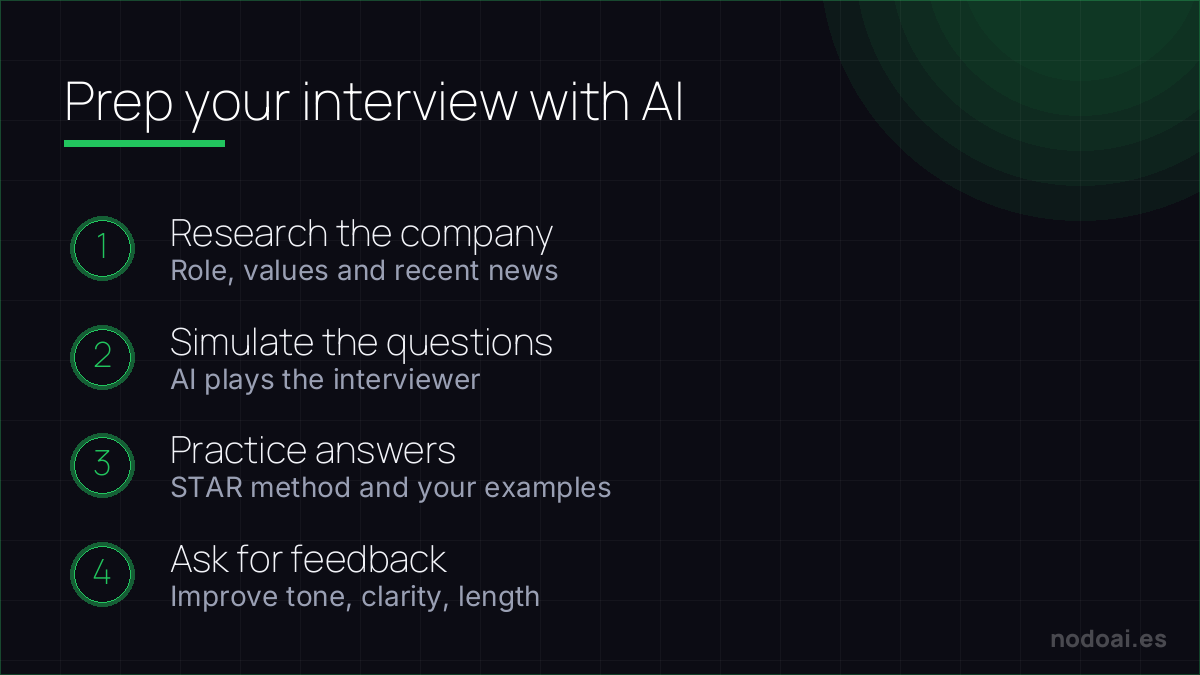
- Research the company: ask for a summary of what it does, its products and its challenges. Then verify the important bits on their website: AI can be out of date.
- Anticipate the questions: “Act as the interviewer for a [role] position at a [type of company]. Ask me the 10 most likely questions, from the most general to the most uncomfortable.”
- Rehearse for real: answer yourself and ask for corrections: “Evaluate my answer: what’s redundant, what’s missing and how would you make it more concrete?”. This loop is gold.
- Prepare YOUR questions: ask for 5 smart questions to ask the interviewer for that role. Asking good questions scores points too.
- Work on your weak spots: tell it about the CV gap that worries you and rehearse how to explain it honestly, without excuses.
Our experience preparing interviews with AI
- What works best: the uncomfortable-interviewer mode. Explicitly ask it to push back and follow up (“don’t settle for my first answer”). That’s where real rehearsal happens.
- The typical mistake: memorising generated answers. It shows badly and sounds robotic. AI gives you the structure; the anecdotes and examples must be yours.
- The trick nobody uses: rehearsing out loud with your phone recording, then giving it the transcript: “where do I ramble?”. It stings, but it improves you more than ten read-throughs.
Our honest advice: AI can’t give you the confidence of knowing your own story. Use it to practise the predictable 80% and arrive with a clear head for the unpredictable 20%, which is where interviews are decided.
The three things AI nails to prep you
- Mock the interview: “Act as the HR lead at [company] and interview me for the [X] role. One question at a time, and rate my answers.” Practising out loud with feedback moves the needle most.
- Research the company: ask it to summarise what they do, their recent challenges and what they value, so you arrive with real context and smart questions.
- Work your weak spot: “what awkward questions would this CV invite?” prepares you for exactly what you fear.
What AI won’t do for you: the nerves and the human connection. Use it to arrive prepared, not to memorise answers that’ll sound robotic.
Practise with AI without sounding rehearsed
The goal of AI interview prep isn't to memorise answers — it's to think clearly under pressure. Use it well:
- Structure with STAR: Situation, Task, Action, Result — ask AI to turn your real experiences into tight STAR stories.
- Do mock rounds: have it play a tough interviewer for your exact role and give feedback on your answers.
- Prepare your own questions for them — the best candidates interview the company too.
The trap is memorising scripts that come out robotic. Use AI to rehearse the thinking, then speak in your own words. Interviewers hire a person they connect with, not a perfectly recited answer — and that connection is the one thing AI can't fake for you.
Frequently asked questions
Can I use AI during a remote interview?
Bad idea: reading answers live shows, and if they catch you, you’re out. Preparation is legitimate; a teleprompter is not.
Does it help with salary negotiation?
For rehearsing the conversation, yes: ask for a negotiation roleplay with objections. Verify salary ranges in industry sources, not the chatbot.
Conclusion
Preparing an interview with AI is training with an infinite sparring partner: questions, corrections and judgement-free rehearsal. Structure with it, but supply your own stories. To sharpen how you ask, review what prompt engineering is; and if you’re in study mode, see how to study with AI.