Learning a language has always had the same problem: to practice conversation you need someone to talk to, and to fix mistakes you need a teacher. AI changes that: it gives you a patient conversation partner available 24/7. It doesn’t replace a good method, but it supercharges it. This guide explains how to learn languages with AI in 2026, with its uses and its limits.
What AI does very well
- Conversation without embarrassment: you practice speaking or writing with no fear of making mistakes in front of anyone.
- Instant correction: it explains why something is wrong and how to say it better.
- Adapting to your level: it adjusts vocabulary and difficulty to where you are.
- Topic-based practice: it simulates real situations (an interview, ordering at a restaurant, a meeting).
- Explanations on demand: grammar questions answered on the spot, with examples.
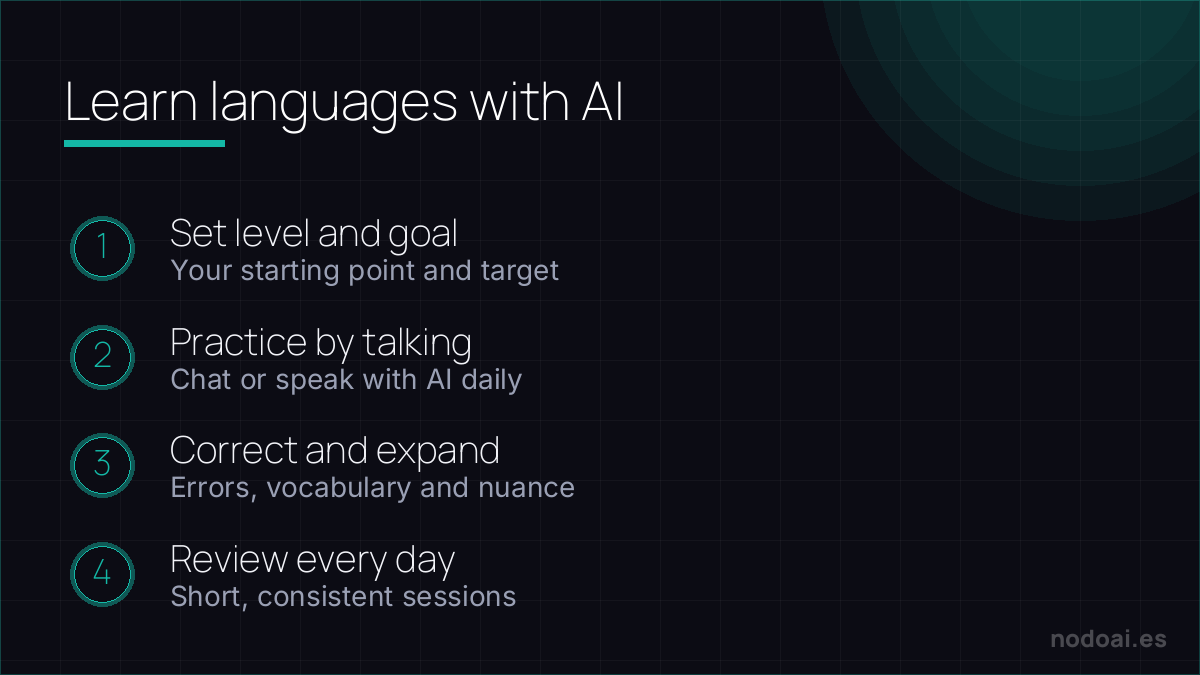
A method that works with AI
- Set a goal: “hold a work conversation” beats “learn English”.
- Practice daily even if briefly: consistency beats occasional marathons.
- Speak, don’t just read: use AI to produce language, not only to consume it.
- Always ask it to correct you: tell it to point out your mistakes and patterns.
- Review what you learned: ask it to quiz you on previous days.
The limits you should know
AI is an excellent complement, but it has flaws. It can give incorrect grammar explanations with full confidence, especially on nuances or in less common languages. It doesn’t replace real immersion or contact with native speakers, who bring culture, accent and naturalness. And pronunciation, though improving, still needs real practice. Use it to practice a lot; double-check anything doubtful.
Does it replace language apps?
Not entirely. Classic apps are good for structured vocabulary and motivation streaks; AI shines at free conversation and personalized correction. The ideal is to combine them: the app for the base, AI for speaking and resolving doubts.
Our experience learning languages with AI
- Its big advantage: an endless, judgement-free conversation partner, available 24/7. To practise and lose the fear of speaking, it’s among the best there is.
- What to watch: sometimes it accepts a phrase a native wouldn’t say. Cross-check the nuances and combine AI with real input (shows, books, people).
- The limit: real pronunciation and listening. AI helps, but talking to people is still irreplaceable.
Our advice: use it to practise daily with no excuses, and leave contact with real speakers for polishing what no app gives you. Consistency beats the perfect method.
Frequently asked questions
Can I learn a language with AI alone?
You can progress a lot, especially in comprehension and written and spoken production. But for real fluency, combine it with native content and, if you can, conversation with people.
Does AI correct grammar well?
Generally yes, but it can be wrong on nuances with an air of certainty. For important rules, check against a reliable source.
Is it useful for pronunciation?
It helps with voice features, but pronunciation needs real listening and practice. Use it as support, not your only reference.
Is it free?
You can start with the free plans of AI assistants. For intensive use or advanced voice features you may want a paid plan, but it isn’t essential.
Conclusion
- AI gives you 24/7 conversation and personalized correction without embarrassment.
- It works best with a clear goal and daily practice.
- It can be wrong on fine grammar: double-check what matters.
- Combine it with native content; it doesn’t replace real immersion.
More in how to make a résumé with AI and how to make concept maps with AI.
And for everyday use, here are the best AI translators compared.