You save articles you never reread, jot down ideas you never find and highlight books you forget. The problem isn’t lack of information: it’s that your knowledge is scattered and mute. A “second brain” is a system where everything you learn stays stored and retrievable — and AI has changed it completely: you no longer need to be an organization freak, because now you can ask your notes.
What a second brain is (and what AI changes)
- The classic idea: capture notes, ideas and references in one place (Notion, Obsidian, etc.) with tags and structure. It works… if you keep the discipline of organizing it.
- The AI twist: perfect organization stops being a requirement. You save quick and dirty, and AI searches by meaning: “what did I note about pricing last year?” finds the note even if you never tagged it.
- The mental shift: you go from “filing well” to “capture everything, ask later”. Far more sustainable.
The minimum viable system (3 pieces)
- 1. One single capture point: the app doesn’t matter; what matters is that it’s ONE and always at hand. The rule: if saving something takes more than 10 seconds, you won’t do it.
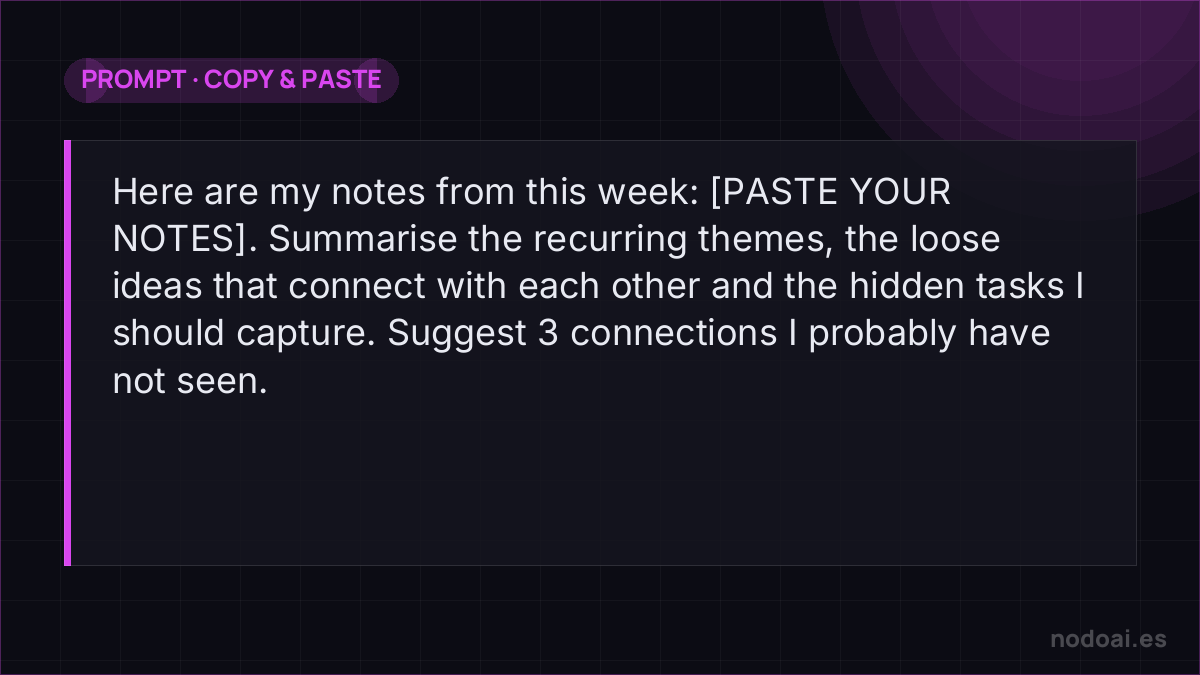
- 2. An AI-assisted weekly review: once a week, ask the AI to summarize what you captured: repeated themes, loose ideas that connect, hidden tasks. It’s the habit that turns the warehouse into a brain.
- 3. Ask before you browse: get used to interrogating your notes (“what did we decide about X and why?”) instead of navigating folders. This is where the system pays off.
The tools, by style
- Notion + its AI: the all-rounder — notes, databases and an AI that searches and summarizes inside your workspace. Ideal if you like structure.
- Obsidian (+ local AI): your notes as your own files, on your disk. Combined with local AI, it’s the sovereign option: nobody else touches your knowledge.
- NotebookLM: the “ask your sources” specialist: upload documents and notes and converse with them, with citations. Brutal as a per-project research brain.
- Claude Projects / GPTs: if you already live in a chatbot, a project with your master notes as knowledge base is an express second brain.
Capture is easy; retrieval is the whole point
A “second brain” only pays off if you can find what you saved. AI tools (Notion AI, Mem, Reflect, Obsidian with plugins) help summarise and surface notes — but the system beats the tool.
- Capture consistently: one inbox for everything, processed regularly. Scattered notes AI can't connect.
- Let AI summarise and link, then check it: a synthesis you didn't verify can quietly invent a connection.
- Retrieval first: tag and title so future-you (and the AI) can actually pull the right note.
The goal isn't hoarding information — it's trusting that what you need is one search away. AI makes a good system great; it can't rescue a messy one.
Our take
- The classic mistake is building the cathedral: weeks configuring templates and zero useful notes. Start ugly: one app, one daily note, one weekly review.
- AI doesn’t excuse you from thinking: summarizing isn’t understanding. Use the weekly review to rewrite what matters in your own words — that’s what fixes knowledge.
- Privacy first: your second brain will end up containing your life. Choose your tool with that yardstick, and review our AI privacy guide.
Frequently asked questions
Do I need to pay to start?
No. The free plans of Notion, Obsidian or NotebookLM are plenty to begin. Pay only when the system is already giving you value.
What if my notes are already scattered in a thousand places?
Don’t migrate everything: it’s the perfect trap to quit. Start fresh with the new system and bring old notes over only when you need them.
Conclusion
An AI second brain isn’t about writing everything down, it’s about not losing what you already think. Capture easily, review with help and ask often. To choose your tools well, see our ChatGPT profile and the best free AI courses to go deeper.