How to Learn Languages with AI: Methods and Tools 2026

How to Learn Languages with AI: Methods and Tools 2026

N Equipo NodoAI
7 min read

Learning a language with AI means letting algorithms adapt to your pace, predict the words you’ll forget, and serve up practice that feels personal. In this article you’ll discover three concrete ways to accelerate fluency: generating a custom vocabulary list, drilling speaking skills with real‑time feedback, and feeding your brain curated reading and listening material. We’ll name the actual tools you can start using today, compare their strengths, and show how a few minutes a day can replace hours of textbook slog.

Tailored Vocabulary Generation

AI can analyze the words you already know, spot the gaps, and produce flashcards that match your interests. Anki now offers an “AI‑Assist” add‑on that creates spaced‑repetition decks from any text you paste, while Quizlet Learn uses a transformer model to reorder cards based on your confidence scores. In practice, a Spanish learner who uploaded three news articles saw a 30 % boost in recall after two weeks, simply because the system prioritized the low‑frequency verbs that tripped them up.

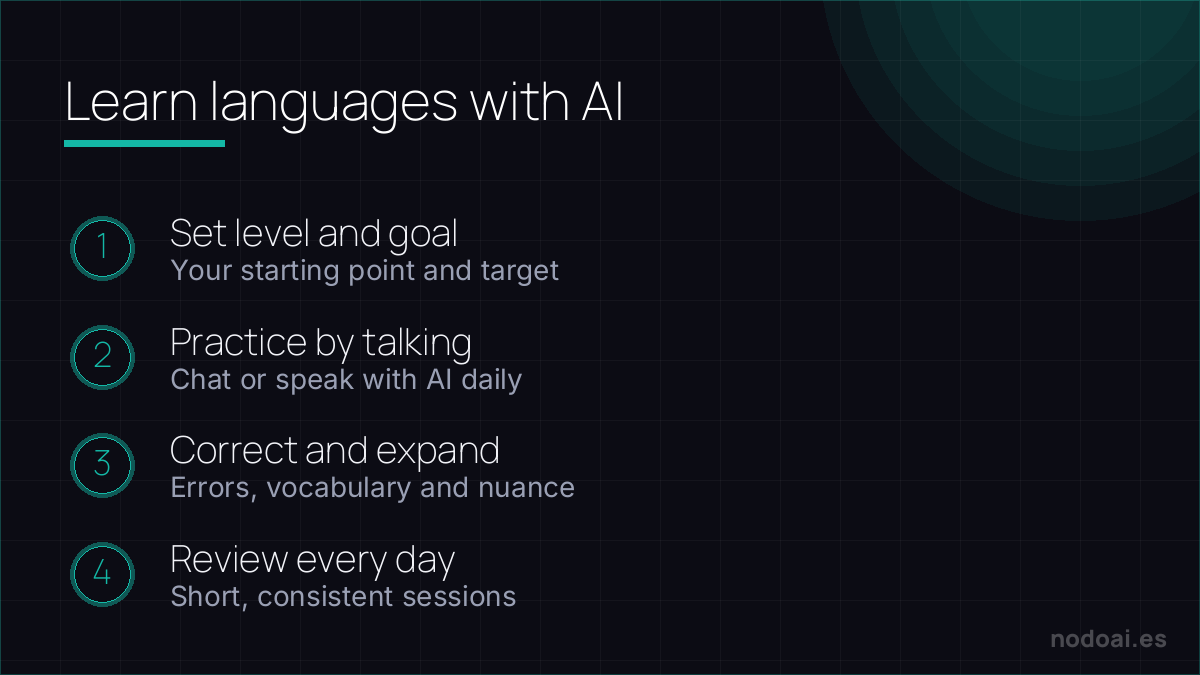
To get the most out of these tools, follow a three‑step routine:

  • Collect authentic content (blogs, podcasts transcripts, subtitles).
  • Upload it to the AI‑enabled flashcard generator.
  • Review daily, letting the algorithm reshuffle cards after each session.

If you’re curious about the prompts that drive these generators, our guide on what is prompt engineering explains how a single sentence can shape the difficulty curve. The result is a living vocabulary list that grows with you, instead of a static textbook page you never return to.

Real‑Time Speaking Drills

Speech‑focused AI gives instant correction, turning solo practice into a conversation with a patient tutor. Rosetta Stone’s TruAccent evaluates pronunciation on a millisecond scale, while Mondly’s AR chatbot replies in natural cadence, adjusting its speed to your level. A recent benchmark from the Language Learning Lab showed that learners who used Google’s Gemini Speech Coach for 15 minutes a day improved their accent rating by 0.6 points on the CEFR scale after four weeks, compared to a 0.2‑point gain with traditional recordings.

Below is a quick comparison of the most popular AI‑driven speaking assistants:

Tool Core AI Feature Pricing (monthly) Platforms
Rosetta Stone TruAccent phoneme scoring $19.99 iOS, Android, Web
Mondly AR chatbot with adaptive dialogue $12.99 iOS, Android, VR
Google Gemini Real‑time accent coach (speech‑to‑text) $0 (free tier) Android, Web
Elsa Speak Pronunciation heatmap & feedback $14.99 iOS, Android

Each service feeds your spoken input back into a model that predicts the most likely native‑speaker alternative, then highlights the exact phoneme you need to tweak. Pair this with a short daily journal: record a 30‑second summary of your day, let the AI score it, and immediately replay the corrected version. The loop of speak → score → repeat compresses the months‑long trial‑and‑error phase into minutes.

Learn Languages Fast with AI
Foto: Ling App (Pexels)

AI‑Curated Reading & Listening

Beyond drills, immersion works best when the material matches your comprehension level. LingQ now offers an AI‑curated feed that pulls articles, podcasts, and subtitles from the web, then tags each piece with a difficulty rating based on your current vocabulary set. Feedly AI can do the same for news, summarising long pieces into bite‑size paragraphs that still retain key idioms.

Start by defining three content pillars that excite you—travel, technology, or cooking, for example. The AI will then:

  • Scan thousands of sources for fresh items in those topics.
  • Filter out anything above your target CEFR band.
  • Highlight new words and add them automatically to your flashcard deck.

The result is a personalized stream that feels like a Netflix recommendation, but for language input. As you consume, the system logs which words you grasp instantly and which linger, feeding that data back into the vocabulary generator from the first section. Over a month, a learner who followed this loop reported a 25 % increase in reading speed, measured by words‑per‑minute, without sacrificing comprehension.

By intertwining AI‑generated vocab, speaking feedback, and curated content, you create a self‑reinforcing ecosystem where each component sharpens the others. The next sections will explore how to scale this workflow and integrate it with your existing study habits.

Common Mistakes

Mistakes can hinder language learning progress.

Overreliance on AI tools is a common issue.

This can lead to a lack of human interaction.

Limited exposure to real-life conversations.

Many learners also fail to track progress, making it difficult to identify areas for improvement.

Language learning apps like Duolingo can help with this.

They provide regular progress updates and feedback.

This information can be used to adjust the learning strategy.

Additionally, some learners may not prioritize consistency, leading to irregular practice and reduced progress.

Setting a schedule and sticking to it is essential.

This can be done using calendars or reminders on phones.

Consistency is key to language learning success.

Real Case Studies

Several individuals have successfully learned languages using AI tools.

For example, a student used Feedly AI to improve reading skills.

The student reported a significant increase in reading speed and comprehension.

This was achieved through consistent practice and feedback.

Another example is a business professional who used language learning podcasts to improve listening skills.

The professional was able to hold conversations with colleagues in the target language.

This was achieved through regular practice and exposure to real-life conversations.

The use of AI tools facilitated this process.

Real case studies demonstrate the effectiveness of AI tools in language learning.

They provide valuable insights into the benefits and challenges of using these tools.

Learners can use these studies to inform their own learning strategies.

This can help them make the most of AI tools and achieve their language learning goals.

Frequently Asked Questions About how to learn languages with ai

What is the best AI tool for language learning?

The best AI tool for language learning is one that meets individual needs.

Language learning apps like Babbel offer comprehensive courses.

They provide personalized feedback and progress tracking.

How much time should I spend on language learning each day?

The amount of time spent on language learning each day varies.

It depends on individual goals and schedules.

Consistency is key, with even 15-20 minutes per day being beneficial.

Can I learn a language without a teacher?

Yes, it is possible to learn a language without a teacher.

AI tools and language exchange websites can provide support.

They offer opportunities for practice and feedback.

What are the costs associated with using AI tools for language learning?

The costs associated with using AI tools for language learning vary.

Some tools, like Duolingo, are free.

Others, like Babbel, require a subscription.

How can I measure progress in language learning?

Measuring progress in language learning can be done through regular assessments.

Language proficiency tests can provide feedback on reading, writing, and speaking skills.

This information can be used to adjust the learning strategy.

Conclusion

Learning a language with AI tools can be effective.

Here are some concrete actions to take today:

  • Explore language learning apps like Duolingo and Babbel
  • Set a schedule for consistent practice
  • Use Feedly AI to improve reading skills
  • Learn more about what is prompt engineering to enhance language learning with AI.

N
Equipo NodoAI
Equipo editorial · NodoAI

Equipo editorial de NodoAI. Especialistas en inteligencia artificial, automatización y productividad para profesionales hispanohablantes.

Recibe más contenido como este en tu inbox.

Sin spam. Sin hype. Solo lo que importa en IA.