Few things are as daunting as a speech: your best friend’s wedding, a graduation, a colleague’s farewell, the company presentation. And there are few tasks where AI helps as much —not by writing it for you, but by drawing out your stories, giving them structure and killing the fear of the blank page. Here’s the method for writing a speech that sounds like you (and not like a machine).
The golden rule: AI structures, you move people
- What AI does brilliantly: the architecture (opening, stories, emotional turn, close), the rhythm and polishing clumsy sentences.
- What only you have: the real anecdotes, the concrete details and the affection. A speech without that is a pretty form letter.
- The consequence: never ask “write me a wedding speech”; the result will be generic. The right method starts by extracting what’s yours.
The method in 4 steps
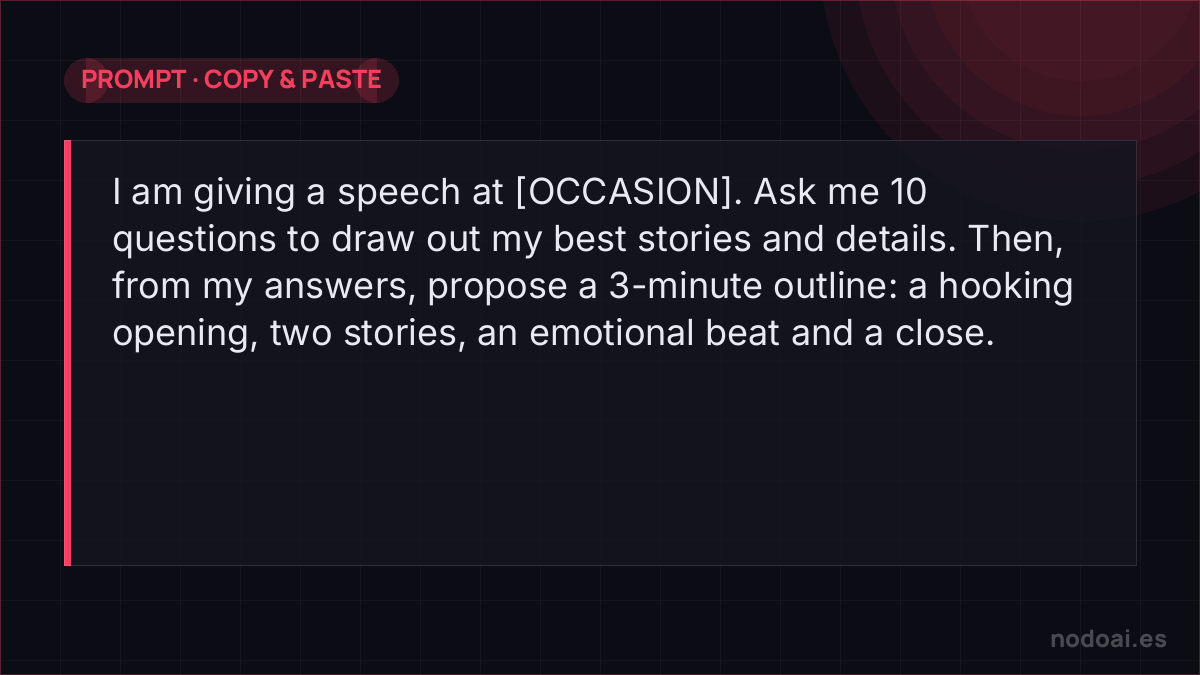
- 1. Have it interview you: “I’m giving a speech at [occasion]. Ask me 10 questions to draw out the best stories and details”. Answer truthfully and unfiltered; that’s where the gold is.
- 2. Ask for the structure, not the text: “with this, propose a 3-minute outline: a hooking opening, two stories, an emotional beat and a close”. You decide which story makes it.
- 3. Write the draft in your own words and hand it over: “improve rhythm and transitions WITHOUT changing my tone or my expressions”. That’s the balance.
- 4. Rehearse out loud: ask for the “spoken version” (short sentences, marked pauses) and read it standing, with a timer. What trips on paper gets cut; what sounds like you stays.
Tricks by occasion
- Wedding: one concrete story beats ten adjectives. Ask the AI to help you pick THE anecdote and land it into the toast.
- Work: clarity above all: one central message, two supports and a close with the next step. AI is superb at trimming corporate filler.
- Graduation or farewell: the emotion-humour balance is the hard part; ask for two versions (one more emotional, one lighter) and blend the best.
A speech that sounds like you, not like a robot
AI can draft a wedding toast, a work presentation or a eulogy in seconds — but a generic speech falls flat in a room. Make it yours:
- Feed it the specifics: real anecdotes, names, inside jokes, the one thing you want people to remember.
- Ask for your tone: “warm and a bit funny, not formal”, and give it a sample of how you talk.
- Read it aloud and cut: if a line doesn't sound like something you'd actually say, rewrite it.
AI is a brilliant first-draft partner for the blank-page panic. The emotion, the real memories and the delivery are what land — and those only you can bring.
Our recommendation
- Less is more: 3 excellent minutes beat 10 correct ones. Give the AI the time limit and let it force you to cut.
- Never read it for the first time at the event: three out-loud rehearsals minimum. AI can play the audience: ask it to anticipate reactions or grill you with awkward questions if it’s a work speech.
- Our take: the speech is the perfect example of good AI collaboration: it brings the craft (structure, rhythm), you bring the irreplaceable (truth, stories, voice). Done this way, nobody will notice the AI —they’ll notice you spoke well.
Frequently asked questions
Will people tell I made it with AI?
Only if you deliver the raw output: pompous phrases, zero anecdotes and that greeting-card tone. If the stories are yours and you edit in your voice, the AI is invisible: in the end, you’re the one saying the words.
How long should a speech be?
Wedding or celebration: 2-4 minutes. Work: whatever the content demands, no filler. In doubt, short: nobody has ever complained about a brief, good speech.
Conclusion
A good AI-assisted speech is built backwards from what you’d expect: first your stories (let the AI interview you), then the structure, then the final polish without losing your voice. Rehearse out loud and cut. If the speech is for a celebration, complete it with planning the event with AI; and to master the art of asking, what prompt engineering is.