Your personal brand is what people say about you when you’re not in the room: your professional reputation made public. Building it takes time and many don’t even know where to start. AI won’t give you a personality or a track record —that’s yours— but it removes the excuses: it helps you define your message, produce content consistently and never stare at a blank page. Here’s how to use it without sounding like a robot.
What a personal brand is (and isn’t)
- It’s your positioning: the topic you want to be known for and the value you bring to a specific audience.
- It’s NOT posturing: a personal brand not backed by something real collapses at the first test. AI helps you communicate what you know, not fake what you don’t.
- It lives over time: it’s built by showing up consistently and with judgement, not with one stray viral post.
Where AI saves you the most work
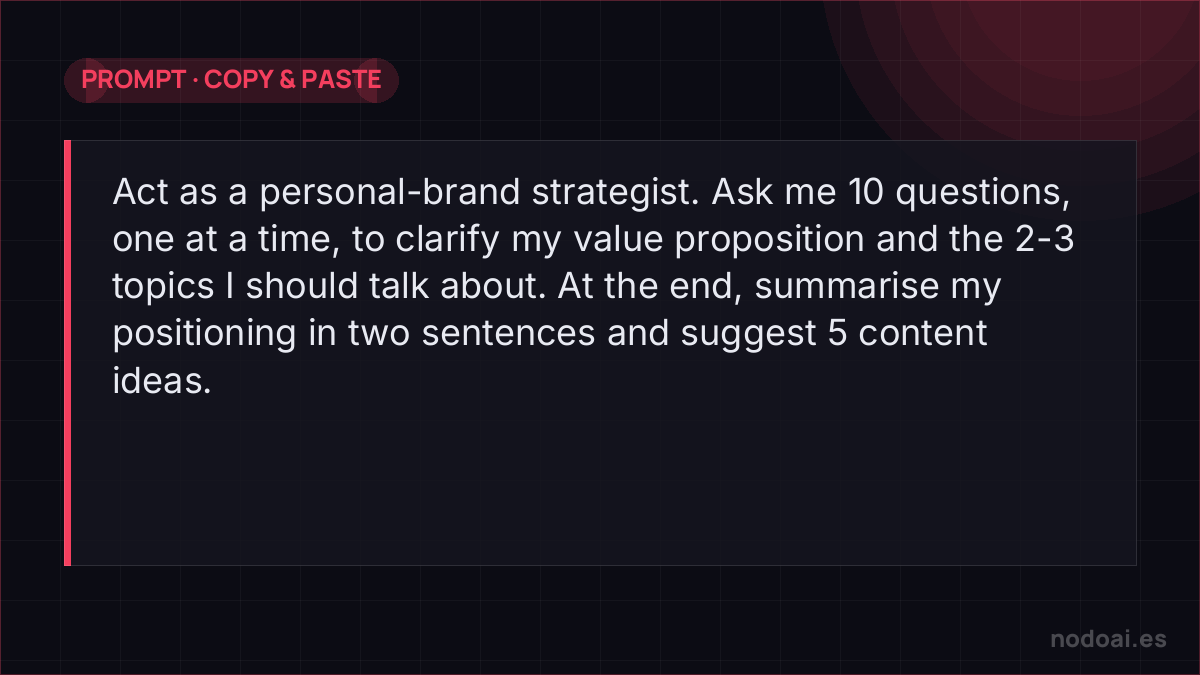
- Defining the message: use it as a sparring partner: “ask me 10 questions to clarify my value proposition” and refine your positioning from its answers.
- Turning ideas into content: you give the idea or experience; AI turns it into drafts of posts, threads or scripts that you then edit in your voice.
- Keeping consistency: what fails most is publishing regularly. AI helps you build an idea bank and recycle one topic into several formats.
- Polishing without losing your tone: it reviews clarity and structure, but the final layer —how you say things— is yours.
A simple method to start
- 1. Focus: pick 2-3 topics you want to talk about and one audience. Less is more.
- 2. Feed the AI your material: give it your experience, opinions and real examples. Without that raw material, you get generic content.
- 3. Build a sustainable rhythm: better 2 good posts a week for months than 20 one week and zero after.
- 4. Always edit by hand: run every draft through your judgement. Publishing raw AI output is the mistake that brands you (badly).
Our take (and what not to do)
- Authenticity first: your voice is your biggest asset. If all your content sounds like AI, your brand stops sounding like you —and people notice.
- Don’t invent credentials or experiences: exaggerating what you’ve done or citing false achievements is the fast lane to losing the trust (and reputation) you’re trying to build.
- Give before you ask: share what you truly know; a personal brand is earned by adding value, not by selling yourself non-stop.
- Our take: AI is a brutal accelerator of consistency and clarity, but a personal brand is built by you with real judgement. Use it so you don’t go blank, not to replace what makes you unique.
Frequently asked questions
Can people tell if I use AI for my content?
They can tell when you publish raw, unedited output: generic sentences, same rhythm, zero personal anecdotes. If you use it as a draft and rewrite it in your voice with your examples, it’s invisible and perfectly legitimate.
Where do I start from zero?
With the message, not the aesthetics: define what you want to be known for and who you help. With that clear, AI helps you produce; without it, it just generates pretty noise.
Conclusion
Building a personal brand with AI is about communicating what you already know better, consistently and without losing your voice. Define the message, produce with help and always edit. To take it to the platforms, see how to use AI for your social media; and if you want to monetise your audience, our guide to making money with AI. The idea sparring, with a chatbot like ChatGPT.