Cloning your voice with AI sounds like science fiction, but today it takes five minutes: you record yourself talking for a while, the system learns your timbre, and from then on you “read” any text without opening your mouth. It’s genuinely useful —and also delicate. Here’s how it works, what it’s worth for, and above all where the line is that you must not cross.
What voice cloning is (and isn’t)
- The idea: the model learns a voice’s characteristics from some samples and then generates new audio in that timbre from written text.
- The good part: some tools create a decent voice from very few seconds of audio; for publish quality, the cleaner and more varied the sample, the better.
- What it is NOT: not infallible magic —it clones timbre, not your intent or judgement. And it doesn’t give you the right to imitate someone else’s voice.
What it’s worth for
- Narration at scale: podcasts, videos or audiobooks in your own voice without re-recording every fix; change the text and regenerate.
- Dubbing and accessibility: keeping “your voice” in another language, or voicing text for those who’d rather listen.
- Fast prototypes: testing voiced scripts before recording for real.
Go-to tools
- ElevenLabs: the quality standard in AI voice; realistic cloning and many languages.
- Resemble AI and Descript: production-oriented; Descript fits if you also edit podcasts or video with a transcript.
- Open-source options (like Chatterbox): for those who want to run locally and not depend on the cloud; more technical to set up.
The red line: consent (read before cloning anything)
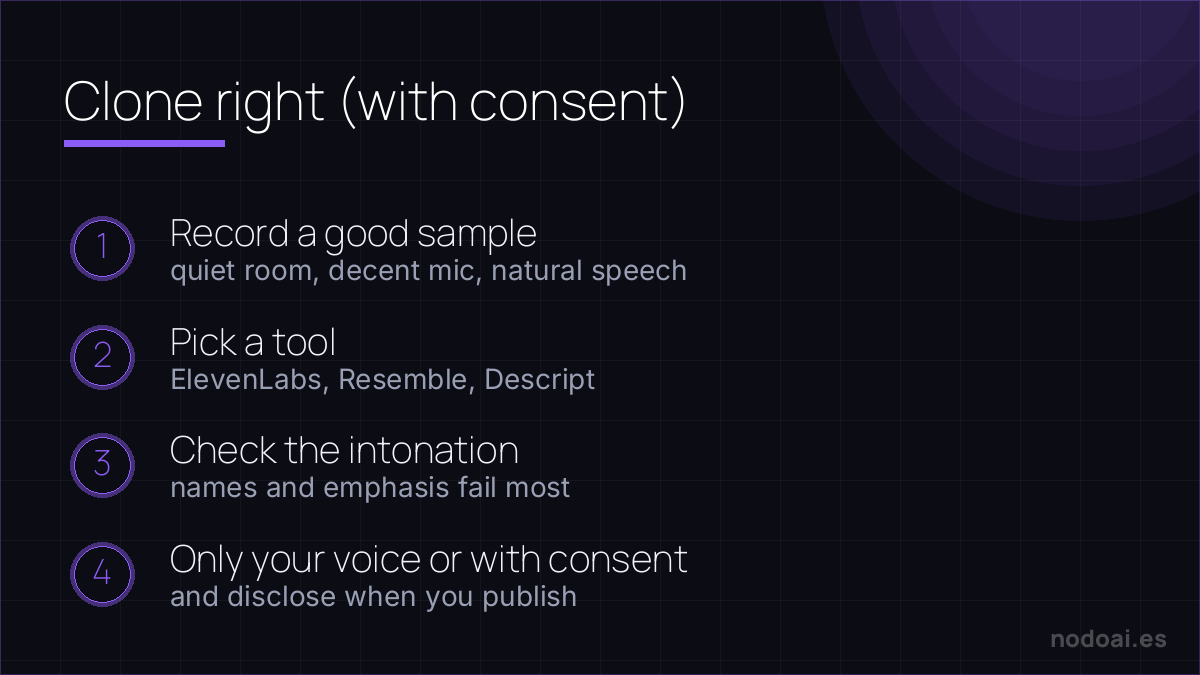
- Clone ONLY your voice or one with explicit permission: imitating someone else’s voice without their consent can violate their rights and, in many places, the law. Don’t do it.
- No impersonation: using a cloned voice to pass audio off as real (scams, hoaxes, “voice deepfakes”) is a harmful and potentially criminal use.
- Transparency: if you publish content with a cloned voice, say it’s AI when the listener might believe it’s a real recording. It builds trust and saves you trouble.
The one rule that matters: consent
Voice cloning is impressively easy now, which is exactly why the ethics come first:
- Only clone a voice you have the right to: your own, or someone who gave clear permission. Cloning a person's voice without consent is a serious ethical — and increasingly legal — violation.
- Never use it to deceive: impersonating someone to scam, embarrass or mislead is fraud, full stop.
- Good uses: narrating your own content, accessibility, dubbing your own videos, preserving your voice.
The technology itself is neutral and useful. What separates a helpful tool from a weapon is a single question you must answer honestly before you start: do I have permission to use this voice?
Our recommendation
- Record a good sample: quiet room, decent mic, natural and varied speech. Input quality rules the result.
- Check the intonation: cloning nails the timbre but can miss emphasis or names; listen and fix before publishing.
- Our take: as a tool for your own voice, it’s a huge time saver. As a temptation to imitate others, it’s exactly what you shouldn’t do. Use it with the simple rule of “only my voice or with permission”.
Frequently asked questions
How much audio do I need to clone my voice?
Some tools start with seconds, but for publish quality it’s worth providing a few minutes of clean, varied audio. The more and better the sample, the more natural it sounds.
Is cloning a voice legal?
Cloning YOUR voice, yes. Cloning someone else’s without permission can infringe their image/voice rights and data-protection rules. For commercial or sensitive use, consult a professional —this is guidance, not legal advice.
Conclusion
Cloning your voice with AI is powerful for narration, dubbing and accessibility, always within a clear rule: your voice or with permission, and with transparency. To pick a tool, see the best AI voice tools; and if you want assistants that also converse, the AI that talks to you. Before uploading samples, review how to protect your data with AI.