Buying clothes online has an eternal problem: you don’t know how they’ll look on you until the box arrives. AI virtual try-ons attack exactly that: with a photo of you (or a selfie), they show you how a garment would fit before you buy it. The technology has matured enormously this year —Google has built it right into its search engine— and it’s now genuinely useful. Here’s how it works, how to try it and its honest limits.
How an AI try-on works
- Your photo + the garment: the AI analyses your photo (or generates a “digital model” of you from a selfie) and overlays the garment respecting your posture and proportions.
- Not a pasted costume: good try-ons simulate how the fabric falls, where it wrinkles and how the cut sits, not just “paint” clothes on top.
- The 2026 leap: Google integrated virtual try-on into its shopping search: from a selfie (using its Nano Banana image model) it generates a full-body version of you and “dresses” you in items from the shops. Its separate experimental app (Doppl) shut down in April 2026 as the feature moved into Search.
The ways to try it today
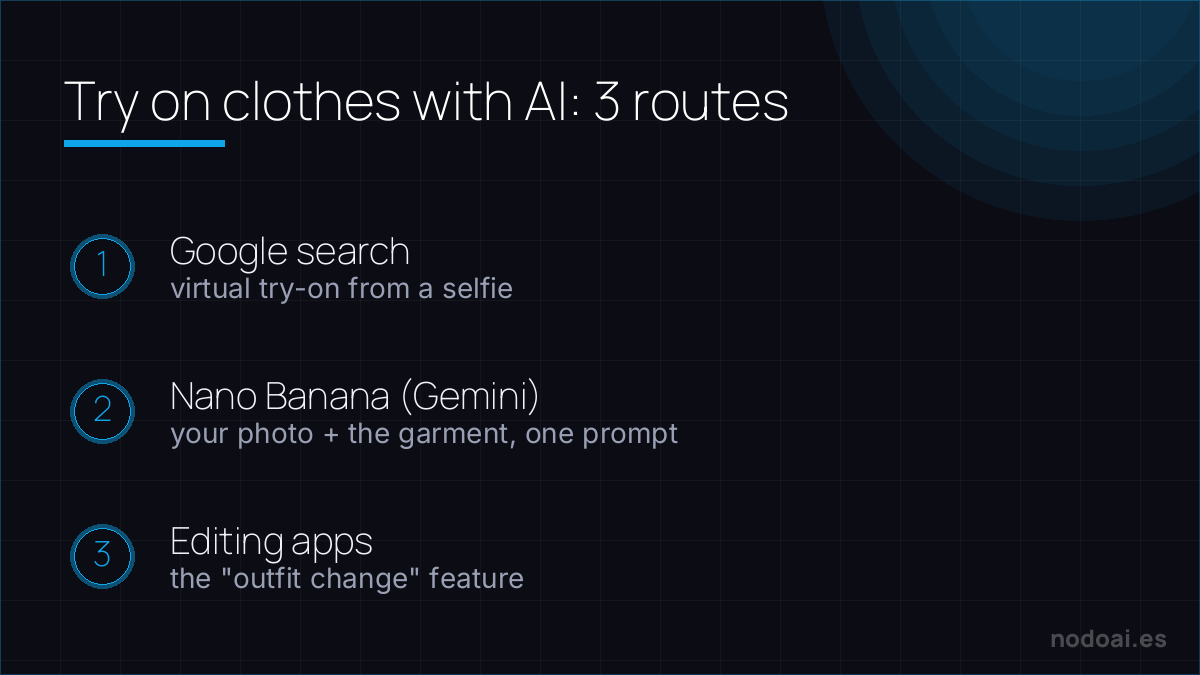
- In Google’s search: when shopping for clothes from shopping results, the “try on” option shows the garment on your photo. The most direct route if you already shop that way.
- With Gemini’s image editor (Nano Banana): upload your photo and the garment’s and ask “dress the person in the first photo with the garment in the second, keep their posture and likeness”. It works surprisingly well and gives you full control.
- Editing apps with outfit change: several editing apps offer “outfit change”; useful for playing with full styles.
What it’s truly for (and what it isn’t)
- It’s for: quickly discarding what doesn’t suit you, comparing colours and styles on yourself, and deciding between two options with more judgement than looking at the shop’s model.
- It does NOT replace sizing: the try-on shows the style, not the exact fit. Keep checking the size guide and measurements; there’s no magic there.
- Beware idealising: some tools “flatter” too much. If the result looks too perfect, take it as guidance, not a mirror.
Virtual try-on: great for style, not for sizing
AI try-on lets you see a garment on your photo (or a model) before buying — a real help for one decision and a trap for another:
- Trust it for: colour, overall style, whether a look suits you, how pieces combine.
- Don't trust it for fit: AI drapes fabric plausibly, it doesn't know your exact measurements or how that specific material falls.
For shops, it can lift sales and cut returns — as long as the preview is honest about being a simulation. For shoppers, use it to narrow choices, then check the real size chart. It answers “would I like this?” far better than “will this fit me?”
Our recommendation
- Full-body photo, fitted clothes and good light: that’s the basis for the simulation to respect your real proportions.
- Privacy first: you’re uploading photos of your body. Use serious services, check what they do with your images and review how to protect your data when using AI.
- Our take: the AI try-on is already an excellent “pre-filter” that saves returns and impulse buys. For fine sizing, the measuring tape still rules.
Frequently asked questions
Is trying on clothes with AI free?
Essentially yes: Google’s search feature is free and Gemini’s editor allows it on its free plan. Some specialised apps charge for advanced uses or watermark-free results.
Is the result faithful to how it will fit me?
For style, colour and general proportion, fairly. For exact size and fabric feel, no: that still depends on the size guide and, ultimately, trying it on physically. Use it to decide better, not as a guarantee.
Conclusion
Trying on clothes with AI has gone from curious trick to useful shopping tool: filter styles on your own photo before spending. Do it with a good photo, serious services and the size always verified. If you enjoy playing with your image, also see professional AI portraits and what Nano Banana can do with your photos.