The question is no longer whether to use AI in your studies, but how to use it without learning nothing (or getting into a plagiarism mess). Used well, AI is the best private tutor you’ve ever had: it explains, corrects and challenges you. Used badly, it’s a machine for handing in work you don’t understand. Here’s how to truly make the most of it, with a clear line between help and cheating.
The line between learning and cheating
- Help (good): having it explain a concept, ask you questions, correct a draft YOU wrote or suggest how to structure an idea.
- Cheating (bad): having it write the assignment for you and handing it in as yours. Besides gutting the learning, many academic policies penalise it and detectors exist.
- The simple rule: AI is your coach, not your substitute. If in the end you couldn’t explain what you hand in, you skipped the part that mattered.
Uses that DO make you learn more
- A tutor that explains at your level: “explain photosynthesis like I’m 12” and then “now at university level”. Adjusting difficulty is gold.
- Testing what you know: ask it to quiz you on the topic; explaining out loud really cements it.
- Feedback on YOUR text: write the essay yourself and ask it to flag weak arguments, logic jumps or unclear parts. You correct and you learn.
- Organising your study: summaries of YOUR notes, outlines and a review plan. Our guide to how to study with AI fits here.
How to do an assignment with integrity
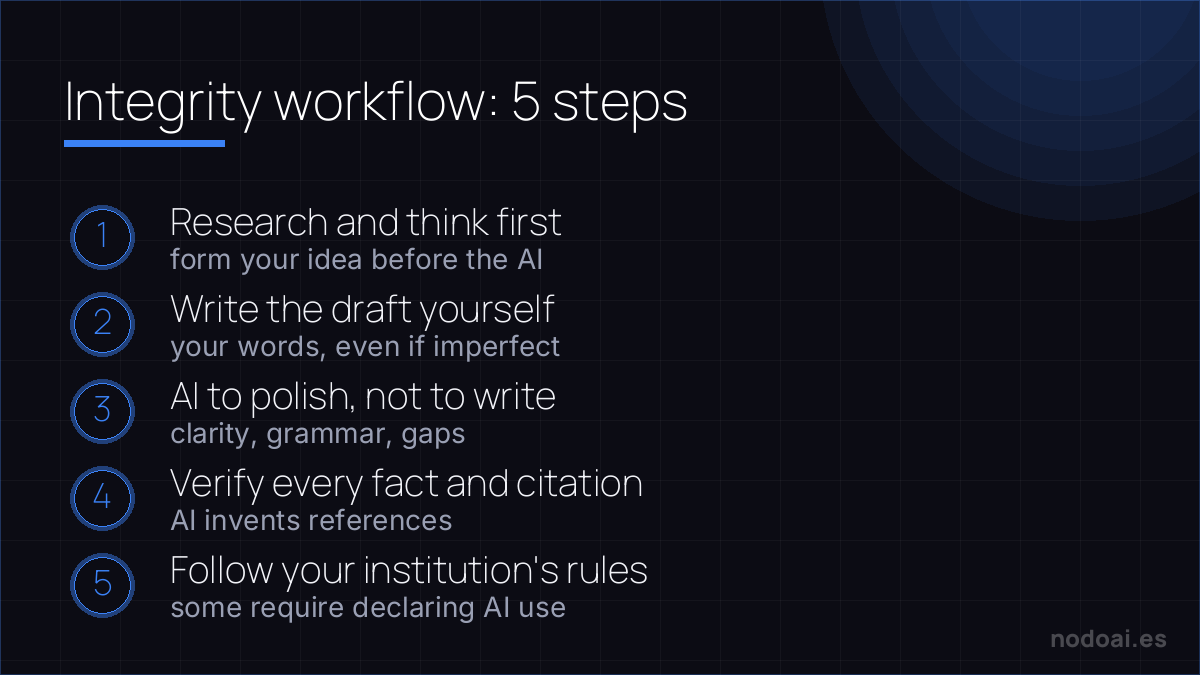
- 1. Research and think first: form your idea and structure before touching AI.
- 2. Write the draft yourself: in your words, even if imperfect.
- 3. Use AI to polish, not to write: clarity, grammar, spotting gaps. You decide which changes to accept.
- 4. Verify EVERY fact and citation: AI invents references and figures. Check each source in the original; a fake citation sinks a paper.
- 5. Follow your institution’s rules: some require declaring AI use. Check and respect them.
Using AI in academic work — on the right side of the line
AI can genuinely help you learn faster; it can also get you expelled. The difference is how you use it:
- Legitimate: explaining hard concepts, generating practice questions, outlining, checking your grammar, brainstorming — support for your thinking.
- Not legitimate: submitting AI-written work as your own. That's plagiarism, and detectors aside, it robs you of the learning you paid for.
Two rules keep you safe: check your institution's specific policy (they vary a lot), and disclose AI use when required. Treat AI as a tireless tutor, not a ghostwriter. The degree is worth something because you earned the understanding behind it.
Our recommendation
- Treat it as an infinite private teacher: ask it a thousand times with no shame, have it quiz you, explain another way. There it hugely beats studying alone.
- Distrust the data: for dates, figures, authors and citations, always verify. AI sounds confident even when it’s wrong.
- Our take: AI can be the biggest learning lever of your life or the shortcut that leaves you knowing nothing. The difference isn’t the tool, it’s whether you use it to understand or to hide. This doesn’t replace your institution’s rules: check them.
Frequently asked questions
Do teachers detect AI?
Detectors exist but aren’t infallible (they give false positives and negatives). Even so, handing in something you don’t understand shows in an oral question. The safe path isn’t “don’t get caught”, it’s using it to genuinely learn.
Can I use AI for my thesis or final project?
For researching, organising, correcting your writing and preparing your defence, it’s a huge help. For writing the original content for you, no: it’s your work and your responsibility. Always check your university’s rules on AI use.
Conclusion
AI in your studies is an incredible tutor if you use it to understand, and an empty cheat if you use it to hide. Learn with it, write it yourself, verify everything and respect your institution’s rules. For the day-to-day, see how to study with AI, these prompts for students and how to use NotebookLM to squeeze your notes.