AI keyword research in 2026 has rewritten the rules of SEO: it is no longer just about volumes and difficulty, but about understanding intent, spotting gaps competitors miss, and optimizing for answer engines like ChatGPT and AI Overviews. 55% of Google searches already trigger AI Overviews and 91.8% of all queries are long-tail. This pillar guide covers the complete AI-assisted keyword research process: a step-by-step methodology, prompts that actually work, tools with real costs, data-driven prioritization, common mistakes, and the questions everyone asks when starting out.
What is AI keyword research
Definition and paradigm shift
AI keyword research is the process of discovering, clustering and prioritizing keywords using language models that understand search intent, instead of relying purely on historical volume databases the way the traditional method did. According to Ahrefs, 94.7% of keywords get fewer than 10 monthly searches — the value lives in the long tail, and AI clusters it better than anything else.
The practical change: you used to export 5,000 keywords from a tool and filter them by hand for days; now a model like Claude groups those same keywords by intent in minutes, surfaces the real questions behind each query and proposes complete content architectures. You still need a volume tool — but the analysis now belongs to AI.
Why it matters more in the AI Overviews era
It matters more than ever because AI-generated answers are absorbing simple informational clicks: a large share of Google searches end without a click, so ranking requires choosing keywords where the click survives or where your brand gets cited inside the answer itself. Pages cited by AI Overviews earn brand visibility and authority even when they lose part of the direct click.
The strategic consequence: modern keyword research sorts every keyword into three buckets — click likely (transactional, comparisons, tools), click at risk (simple informational) and GEO opportunity (questions where you can be the cited source). Your editorial calendar should weight buckets one and three much more heavily.
The complete AI keyword research methodology
Step 1: seed keywords with business context
Step one is giving the AI real business context — what you sell, to whom, which problems you solve — and asking for 50-100 seed keywords organized by funnel stage, something a well-prompted model produces in a couple of minutes. Usage studies consistently show output quality depends more on prompt context than on which model you pick.
A prompt that works: “Act as a senior SEO. My business: [description]. My ideal customer: [profile]. Generate 80 seed keywords grouped by intent (informational, comparison, transactional) and funnel stage, with the real question the user has behind each one.” The output does not replace volume data — it is the initial map you validate next.
Step 2: validation with real data
Step two is crossing your seeds against real volume and difficulty data using Google Keyword Planner (free), Ahrefs, Semrush or LowFruits, because the AI does not know current volumes and will happily suggest keywords nobody searches. Practical rule: keywords under 30 difficulty with over 100 monthly searches are the sweet spot for newer sites.
The efficient flow: export the tool’s data to CSV, hand it to Claude or ChatGPT and ask for the cross-reference — “mark which of my seeds have data, cluster the survivors by topic and rank by opportunity-to-difficulty ratio.” What used to be an afternoon in Excel is now ten minutes.
Step 3: intent clustering
Step three is grouping validated keywords into topical clusters where each cluster equals one article or page, avoiding the classic mistake of one page per keyword when Google already understands synonyms and variants. Sites organized in topical clusters tend to earn more organic traffic than those that create a page per keyword.
AI shines here: feed it 300 keywords and ask “group these into clusters where all keywords can be answered in a single article; for each cluster give me the primary keyword, secondaries, dominant intent and a proposed H1.” Review the output by hand — models get 85-90% right and the misses take minutes to fix.
Step 4: SERP and competitor analysis
Step four is analyzing what already ranks for each cluster — content type (guide, list, comparison), depth, freshness and domain authority — because the SERP tells you exactly which format Google expects for that intent. A meaningful share of sources cited in AI answers come from pages outside the top 10: there is room even if you are not in the top positions.
Practical flow: search the primary keyword in incognito, copy the top-10 titles and descriptions, paste them to the AI and ask “which content pattern dominates, what is missing from these results, and which differentiating angle do you recommend?” That detected gap is your editorial edge.
Step 5: prioritization with an impact matrix
Step five is ranking clusters on an impact-versus-effort matrix that weighs business potential (not just traffic), real SERP difficulty and required resources, to decide what to publish over the next 12 weeks. Transactional keywords convert 10-15x better than purely informational ones — volume is not the queen metric.
A simple template that works: score each cluster 1-5 on volume, purchase intent, inverted difficulty and business fit; multiply and sort. The AI can apply this matrix automatically if you pass it the clusters with their data. Publish high-intent clusters first even when their volume looks modest.
AI keyword research tools compared
| Tool | Strength | Best for | Monthly cost |
|---|---|---|---|
| Claude / ChatGPT | Clustering and intent | Analysis and grouping | $0-25 |
| Google Keyword Planner | Official volumes, free | Data validation | $0 |
| Ahrefs / Semrush | Full data + competitors | Professionals and agencies | $108-140 |
| LowFruits | Weak-spot detection | New sites and niches | $25-60 |
| Search Console + AI | Your own real data | Optimizing existing content | $0 |
The winning zero-budget combination: Keyword Planner for volumes + Claude for clustering + Search Console to find keywords where you already rank 8-20. For under $25 a month you have a complete professional workflow.
Keyword research prompts that work
The niche expansion prompt
To uncover subtopics tools never show, ask the AI to think like your customer: “List 40 questions a [profile] asks before, during and after [problem you solve], in their natural language, not marketing jargon.” Natural-language questions are exactly what triggers AI Overviews and voice assistants.
A powerful variant: ask for the questions “they would ask in a group chat or a forum, not in Google.” This surfaces the conversational long tail growing with AI search — keywords competitors who only check Semrush will never see.
The cannibalization analysis prompt
To detect cannibalization, export your Search Console queries with their URLs and ask: “identify keywords where two or more of my URLs compete, rank the severity, and recommend consolidate, redirect or differentiate for each case.” Silent cannibalization can cost 20-40% of the affected pages’ potential traffic.
This analysis — which consultants charge $300-600 for — takes 15 minutes with your own data. Repeat it quarterly: every new content batch is a fresh cannibalization opportunity.
The full SEO brief prompt
To turn a cluster into content, ask for the complete brief: “For the cluster [keywords], generate an SEO brief: H1, meta title under 60 characters, meta description under 155, H2/H3 structure, FAQ questions, entities to mention and a differentiating angle versus the current top 10.” A solid brief halves writing time and prevents rewrites.
The important nuance: the AI generates the brief, but deciding what to promise the reader and which first-hand experience to add is yours. Content that merely executes generic briefs is exactly what Google and readers are learning to ignore.
Common AI keyword research mistakes
Trusting volumes invented by the model
The most dangerous mistake is asking ChatGPT or Claude for search volumes: models have no access to live search data and will generate plausible but fabricated numbers, so every volume must be validated in Keyword Planner, Ahrefs or Semrush. It is the classic hallucination wearing a costume of precision.
The correct division of labor: AI thinks (intent, clustering, angles, briefs) and tools measure (volume, difficulty, CPC). Any workflow that swaps those roles produces decisions built on fictional data.
Chasing volume over intent
The second mistake is picking keywords by raw volume: a 10,000-search informational keyword can be worth less than a 200-search transactional one, because the second converts and the first may not even generate clicks after an AI Overview. Purchase intent multiplies value per visit by 10-15x.
The antidote: always classify by intent before volume, and reserve at least half your calendar for commercial and comparison keywords even when their numbers look modest next to informational giants.
Ignoring answer engines
The third mistake is researching only for classic Google when a growing share of discovery happens in ChatGPT, Perplexity and AI Overviews, which cite sources with clear structure, concrete data and topical authority. Optimizing to be cited — known as GEO — is now a discipline of its own, covered in our guide to Generative Engine Optimization.
The practical implication for research: include in each cluster the literal questions people ask assistants, and structure content with direct 40-60 word answers at the top of each section — the format answer engines prefer to cite.
Our experience: how we use AI for keyword research without losing judgement
- What speeds us up: generating ideas, grouping by intent and discovering the real questions people ask. To get past the blank page, it’s brilliant.
- The real danger: AI invents search volumes and difficulty scores. Never trust the figures it gives; always validate them with a real-data tool.
- Our flow: AI for clusters and intent → real data to validate volume → human judgement to prioritise what actually suits you.
Our advice: use AI as a powerful brainstorm, not as a data source. You set the strategy; it just saves you the start.
Frequently asked questions about AI keyword research
Can ChatGPT give me search volumes?
No: neither ChatGPT nor Claude has access to real volume data, and any figure they produce is fabricated. Use them to generate ideas, cluster by intent and analyze SERPs — and always validate volumes in Google Keyword Planner, Ahrefs, Semrush or LowFruits before deciding what content to create.
What is the best free tool stack to start with?
Google Keyword Planner + free Claude or ChatGPT + Google Search Console covers 80% of the professional workflow at zero cost: official volumes, intelligent clustering and real data from your own site. Once the site earns revenue, the natural upgrade is LowFruits or Semrush for competitive analysis.
How many keywords do I need per article?
One primary keyword and 5-15 secondaries from the same cluster: Google understands synonyms and variants, so one strong article ranks for dozens or hundreds of related keywords. The one-page-per-variant era is over; today the unit of work is the intent cluster, not the individual keyword.
Is keyword research still worth it with AI Overviews?
Yes, but the criteria change: prioritize keywords where the click survives (transactional, comparisons, tools) and keywords where you can become the source the AI cites. Modern research adds a third question to volume and difficulty: what happens to the click on this SERP?
How often should I redo keyword research?
A light monthly review with Search Console (which new keywords trigger your site) and a full quarterly research cycle: SERPs change fast with AI Overviews and new gaps appear every quarter. In fast-moving niches (AI, finance, tech) shorten the cycle to 6-8 weeks.
How do I find low-competition keywords?
Three reliable paths: LowFruits automatically flags SERPs with weak domains; Search Console shows keywords where you rank 8-20 (Google already considers you relevant — push harder); and AI-generated conversational long-tail questions that traditional tools have not registered yet.
Conclusion: your AI keyword research workflow
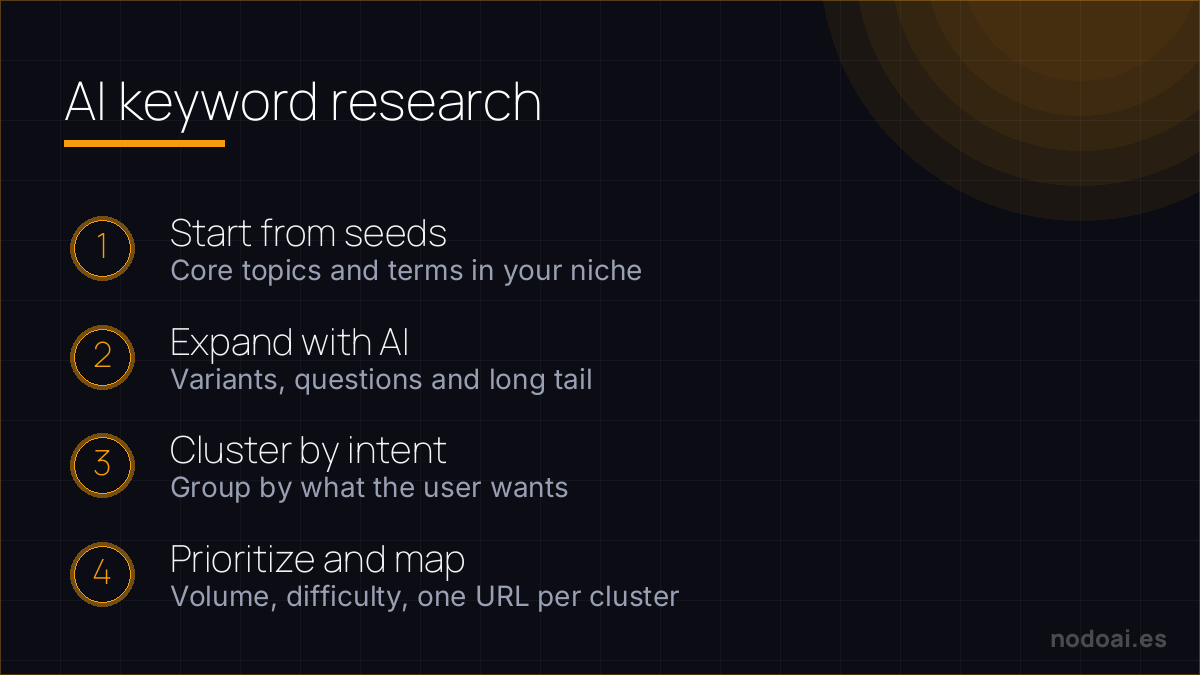
- Seeds: 80-100 keywords with business context generated with Claude or ChatGPT
- Validation: real volumes and difficulty in Keyword Planner, Ahrefs or LowFruits
- Clustering: intent-based grouping with AI — one cluster equals one piece of content
- SERP: top-10 analysis plus a differentiating gap before writing a single line
- Prioritization: impact/effort matrix weighted toward purchase intent, not just volume
- Cycle: monthly Search Console review and full quarterly research
To put this workflow into practice, pair it with our guide to AI for SEO, sharpen your prompts with what is prompt engineering, and grab the ready-to-use SEO skill from the Claude Skills library.