For twenty years, searching the internet meant one word: Google. In 2026 that habit is wobbling. Perplexity and AI answer engines promise to give you the answer directly instead of a list of links. Has the time come to switch search engines? We’ve used them day to day, and here’s our honest comparison.
Two different ways to search
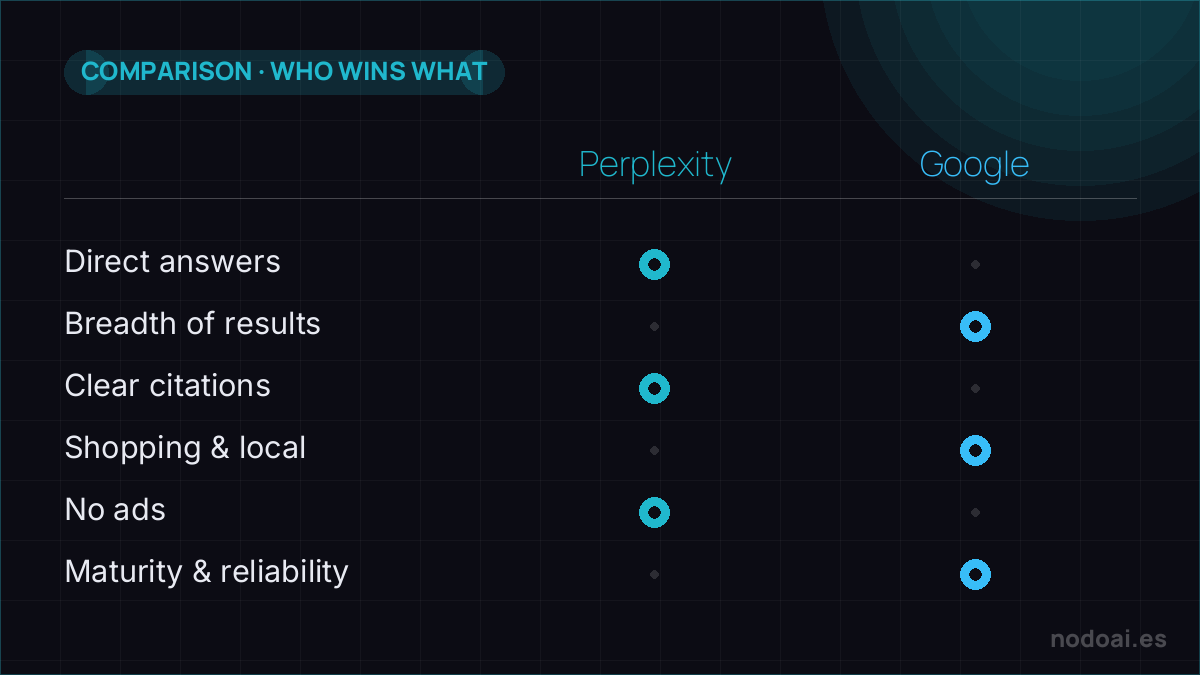
- Google: gives you a list of links so you decide where to go. Absolute king of local, shopping, maps and quickly navigating to a specific site.
- Perplexity: gives you a written answer with its sources cited. It shines when you want to understand something or research without opening ten tabs.
They’re not competing for the same thing: one takes you to the sites, the other summarises what’s on them.
Quick comparison
| For what | Better option |
|---|---|
| Researching a topic in depth | Perplexity |
| Direct answer with sources | Perplexity |
| Finding a local business or hours | |
| Shopping or comparing prices | |
| Going quickly to a specific site | |
| Maps and directions |
Which one for which task
These aren't really enemies — they answer different needs. A quick decision guide:
- Choose Perplexity when you have a real question and want a direct, cited answer: research, “explain this”, comparing options, avoiding ad clutter.
- Choose Google when you need breadth, local results and maps, shopping, or you already know the exact site you want to reach.
In practice most people end up using both: Perplexity to understand a topic with sources you can verify, Google to navigate and buy. The honest test is your own habit — run the same three questions through each for a week and notice which you reach for.
Our recommendation: when to use each
- Use Perplexity when the question starts with “explain,” “compare,” “what do the studies say about…”. It saves you opening tabs and cites sources so you can check.
- Use Google when you’re after something in the real world: a nearby restaurant, a shop’s opening hours, a product to buy, or getting quickly to a site you already know.
- What we do: we don’t choose, we use both depending on intent. Perplexity to understand, Google to act. Switching entirely would mean losing what each does best.
Our honest opinion: it’s not about replacing Google, but about having another tool for the searches that used to be a hassle. For research, the change is noticeable. For everyday stuff, Google still rules.
What’s worth being clear about
- Always verify: AI cites sources, but it can summarise poorly or go out of date. With the sources in front of you, check what matters.
- Privacy: as with any service, look at what data you share before getting used to it.
- This evolves fast: Google is also weaving AI into its results, so the line between the two will keep blurring.
Frequently asked questions
Can Perplexity fully replace Google?
For research and understanding topics, for many it already does. For local, shopping and quick navigation, Google is still more practical. The sensible thing is to combine them.
Can I trust the AI’s answers?
As a starting point, yes; as absolute truth, no. Its advantage is that it cites sources: use them to verify what matters.
Conclusion
Perplexity hasn’t killed Google, but it has changed how we search: direct answers for research, links to act. Try using each based on your intent and keep the best of both. To go deeper, see our Perplexity profile and the state of AI browsers.