Email marketing is still one of the highest-ROI channels there is, and AI has made it much faster: drafting campaigns, generating subject lines, segmenting and automating sequences in minutes. But used without judgment, AI also multiplies the generic spam nobody opens. This guide explains how to use AI in email marketing in 2026 to sell more without burning your list, with the consent and deliverability cautions that truly matter.
Email marketing isn’t “writing an email”
Mind the difference: writing an email is a one-off message; email marketing is sending the right message to the right set of people at the right time, and measuring the result. There AI doesn’t just write: it helps ideate, segment, personalize at scale and improve what isn’t working. It’s a system, not a piece of text.
Where AI adds real value
- Subject lines: generate dozens of variants and test which gets opened more. The subject decides if you get read.
- Campaign copy: drafts of newsletters and promotions that you adjust to your voice and offer.
- Personalization at scale: adapting the message per segment (not just “Hi [name]”), with a relevant detail for each group.
- Automated sequences: welcome series, cart recovery or re-engagement, written and planned.
- Analysis: summarizing metrics (opens, clicks, unsubscribes) and suggesting what to change.
An AI workflow
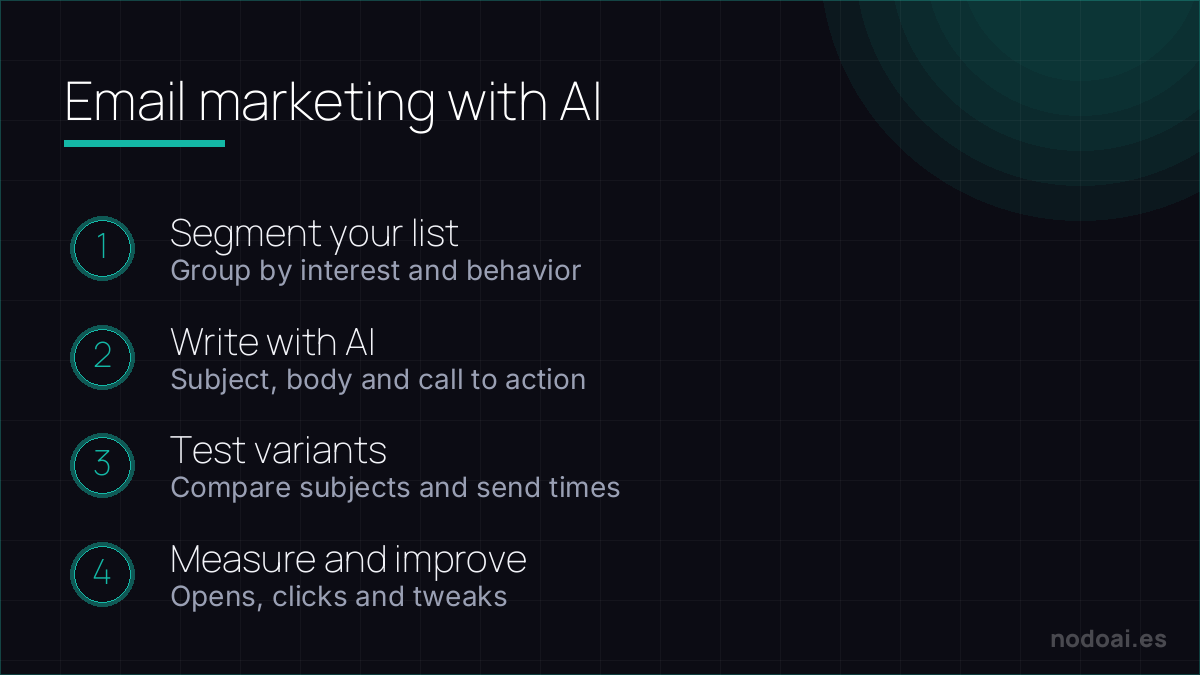
- Define goal and segment: who are you writing to and what do you want them to do? Without this, AI rambles.
- Generate subjects and body: ask for several versions with the offer and tone clear.
- Edit with your judgment: add your voice, your real offer and remove the generic.
- A/B test: compare two subjects or approaches on part of the list before sending to everyone.
- Measure and improve: see what worked and ask AI for ideas for the next one.
The cautions that avoid disaster
- Consent (GDPR): you can only send to those who gave you permission. Buying lists or sending without consent is illegal and wrecks your reputation.
- Don’t generate spam at scale: AI letting you send more doesn’t mean you should. More generic emails = more unsubscribes and complaints.
- Deliverability: 100% generated, “salesy” text triggers spam filters. Write like a human, avoid excess caps and symbols.
- Make unsubscribing easy: a clear unsubscribe link is mandatory and also protects your sending reputation.
- Personalization, not surveillance: use data to be relevant, not to sound creepy.
Metrics that really matter
| Metric | What it tells you |
|---|---|
| Open rate | Whether your subject and sender convince |
| Click rate (CTR) | Whether the content and call to action work |
| Unsubscribes and complaints | A warning sign: you’re tiring your list |
| Conversions | The only thing that actually pays the bills |
What we learned using AI in email marketing
We send a newsletter and have used AI in the process; these are the lessons that stuck with us most:
- Where it pays off most is subject lines. Generating ten variants and running an A/B on part of the list clearly lifted our open rates. We almost always write the body ourselves; the subject is where AI truly saves time.
- We learned about deliverability the hard way. A send with overly “AI” and salesy text went straight to spam on several accounts. Since then we edit it to sound human and avoid caps and over-the-top promises.
The rule we never break: AI speeds things up, but the list is sacred. More generic emails = more unsubscribes. We’d rather send less and give every email a reason to be opened.
Our experience with AI in email marketing
We send a newsletter and we’ve used AI in the process; these are the lessons that stuck with us most:
- Where it pays off most is subject lines. Generating ten variants and A/B testing on part of the list lifted our open rates clearly. We almost always write the body ourselves; the subject line is where AI really saves time.
- We learned about deliverability the hard way. A send with text that was too “AI” and salesy went straight to spam on several accounts. Since then we edit so it sounds human and avoid all-caps and exaggerated promises.
The rule we don’t break: AI speeds things up, but the list is sacred. More generic emails = more unsubscribes. We’d rather send less and have every email earn its open.
Frequently asked questions
Can AI run my email marketing on its own?
No. It speeds up copy, subjects, segmentation and analysis, but the strategy, offer and judgment are yours. It’s a copilot, not autopilot.
Is it legal to use AI to send emails?
Using AI, yes. What the law regulates is who you send to: you need consent (GDPR) and an unsubscribe link. The tool doesn’t exempt you from compliance.
Does generated content land in spam?
It can, if it sounds artificial and salesy. Edit it to read human, avoid excess caps and over-the-top promises, and protect your sending reputation.
Does real personalization improve results?
Yes, a lot: segmenting and adapting the message per group usually lifts opens and clicks versus a generic blast to the whole list.
Do I need an expensive tool?
Not to start. An email platform with a free plan and an AI assistant are enough. Scale when your list justifies it.
In a nutshell
- Email marketing is a system (segment, send, measure), not just writing.
- AI helps with subjects, copy, personalization and analysis; you bring the strategy.
- Respect consent (GDPR) and don’t turn speed into spam.
- Watch unsubscribes and deliverability: your sending reputation is your asset.
Keep reading: how to write emails with AI and automating tasks with AI.